Cold email agencies rarely fail because they cannot write a decent first message. They struggle when client count rises and the operation becomes difficult to control: domains are mixed across accounts, sender ownership is unclear, lists arrive without source history, campaign changes are made in chat, replies sit unowned, and reporting turns into a monthly reconstruction exercise.
A scalable agency needs an operating system, not a collection of disconnected tools. The system should make five things obvious at any moment: which client owns each asset, who is allowed to change it, whether it is healthy enough to use, what happened to each prospect, and what action must happen next.
This playbook is for agencies that manage outbound on behalf of multiple clients. It covers the operating model that sits above individual campaigns: client separation, infrastructure ownership, launch gates, roles, daily controls, reply handoffs, reporting, compliance, change management, and capacity planning. It does not prescribe a universal sending volume or promise inbox placement. Those decisions depend on provider policy, sender history, recipient behavior, list quality, and the evidence available in each client account.
Key Takeaways
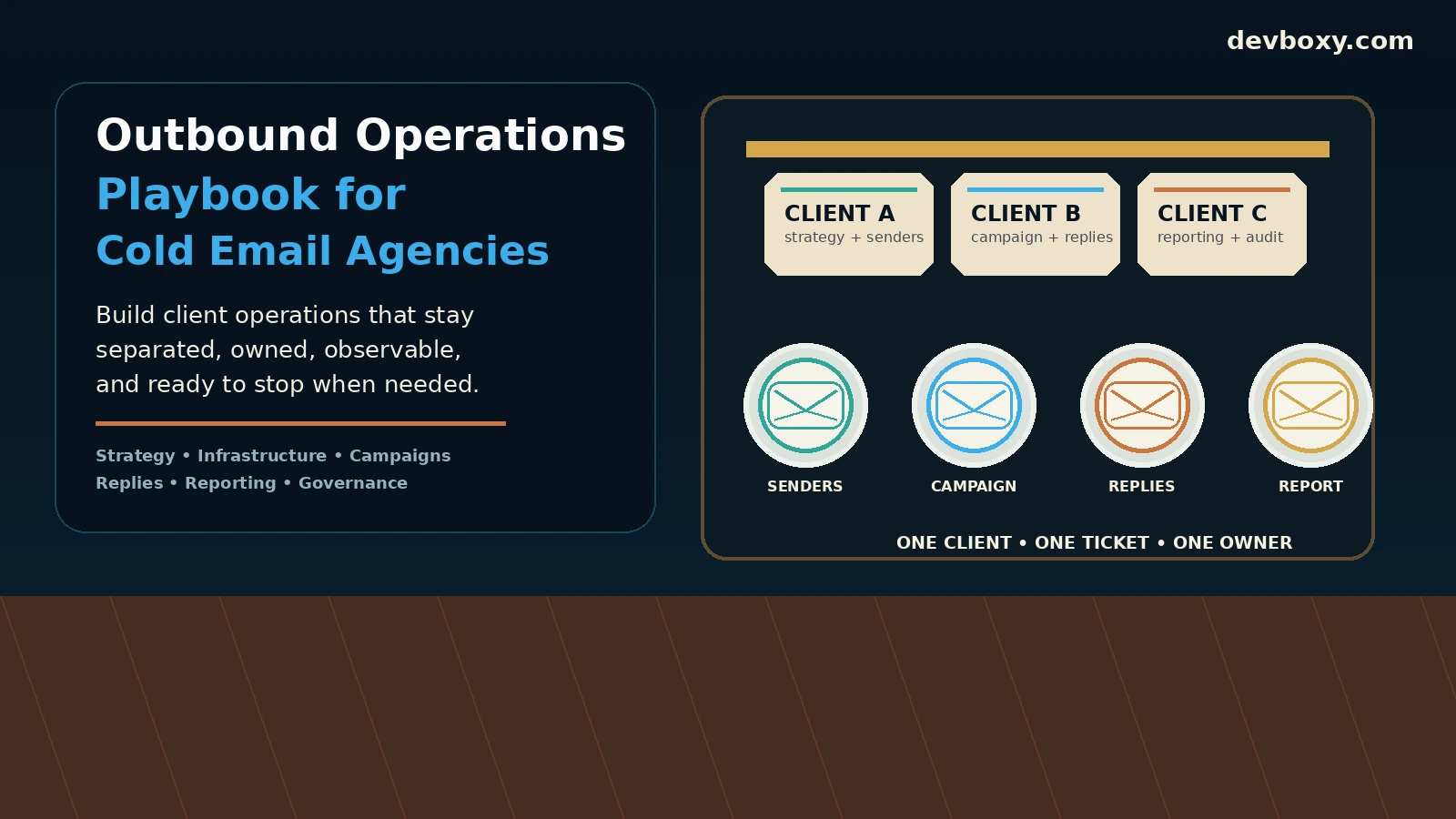
Treat every client as a separate operating boundary with its own domains, sender inventory, campaigns, suppression state, reporting context, and decision history.
Assign ownership before launch. Strategy, infrastructure, campaign execution, replies, reporting, and incident response should each have a named owner and backup.
Use launch gates and change records instead of approving important decisions in scattered chat threads.
Monitor sender health, delivery evidence, reply quality, response handling, and business outcomes as separate layers.
Stop or narrow a client campaign when the evidence changes. A scheduled send is never more important than a reply, opt-out, complaint, authentication failure, or manual hold.
Keep client reporting tied to decisions: what changed, why it matters, what the agency will do next, and what the client must provide.
Scale only after the agency can onboard, operate, audit, and recover one client without relying on one person’s memory.
What Cold Email Agency Operations Actually Includes
Cold email agency operations is the system used to turn a client agreement into controlled outbound execution. It connects commercial commitments with the technical and human work required to deliver them.
A useful operating model spans six functions:
Function | Primary question | Evidence the agency should keep |
|---|---|---|
Client strategy | Who are we trying to reach and why should they care? | ICP, exclusions, offer, approved claims, campaign objective |
Infrastructure | Which domains and senders belong to this client and are they ready? | Asset inventory, DNS checks, mailbox state, ownership, provider |
Data and campaign execution | Which contacts are eligible and what sequence will they receive? | List source, verification status, suppressions, segment, versioned copy |
Reply operations | What happens when a prospect responds? | Reply type, owner, response status, meeting or next-step record |
Reporting | What happened and what decision follows? | Delivery evidence, human replies, positive outcomes, meetings, incidents |
Governance | Can the agency explain and control every material change? | Approvals, access, audit trail, opt-outs, client instructions, incident notes |
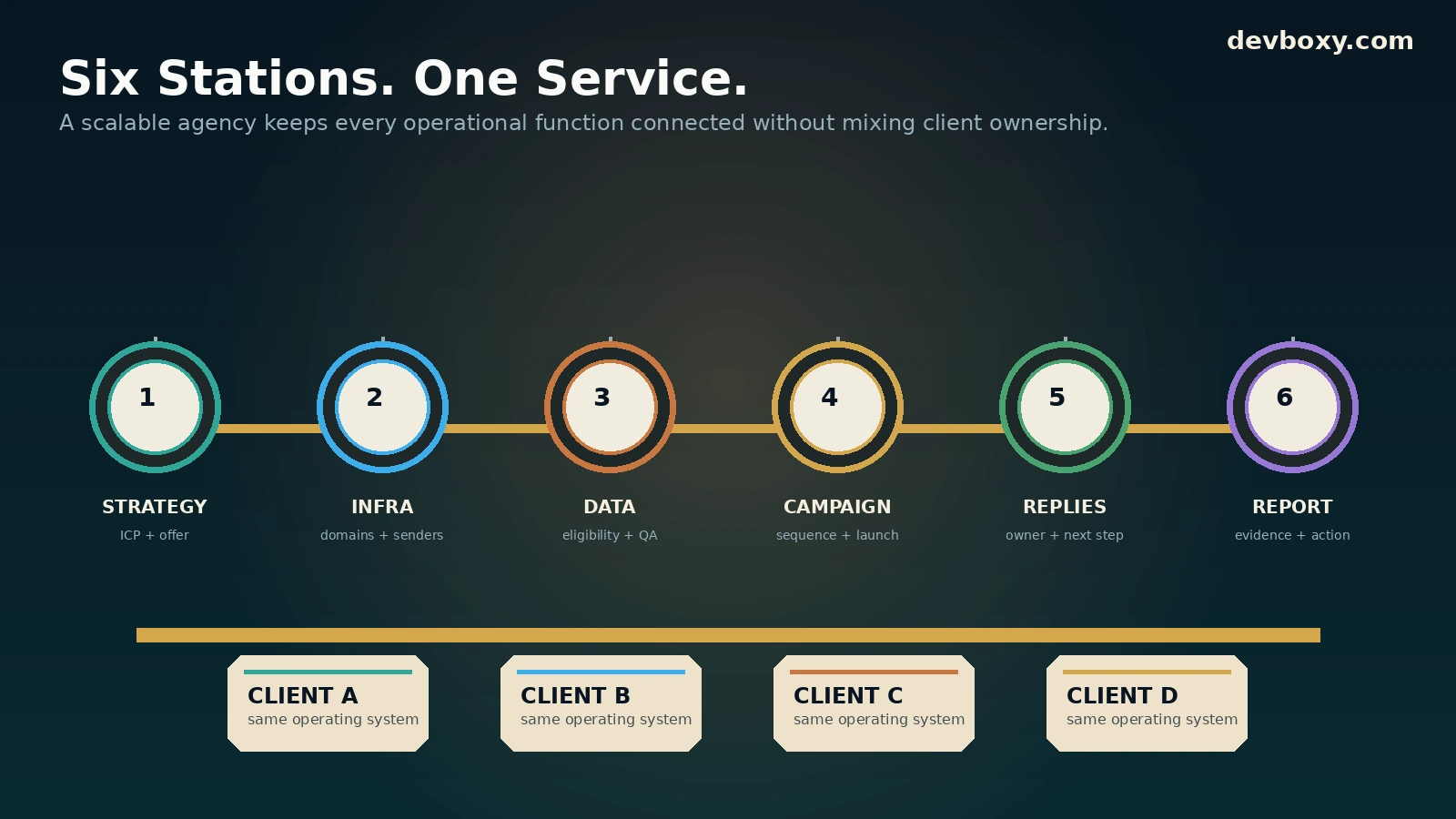
The agency should be able to trace a prospect from source file to campaign to reply to business outcome. If the trail breaks between functions, the team will eventually lose context, send something that should have stopped, or report a number nobody can explain.
Give Every Client a Clear Operating Boundary
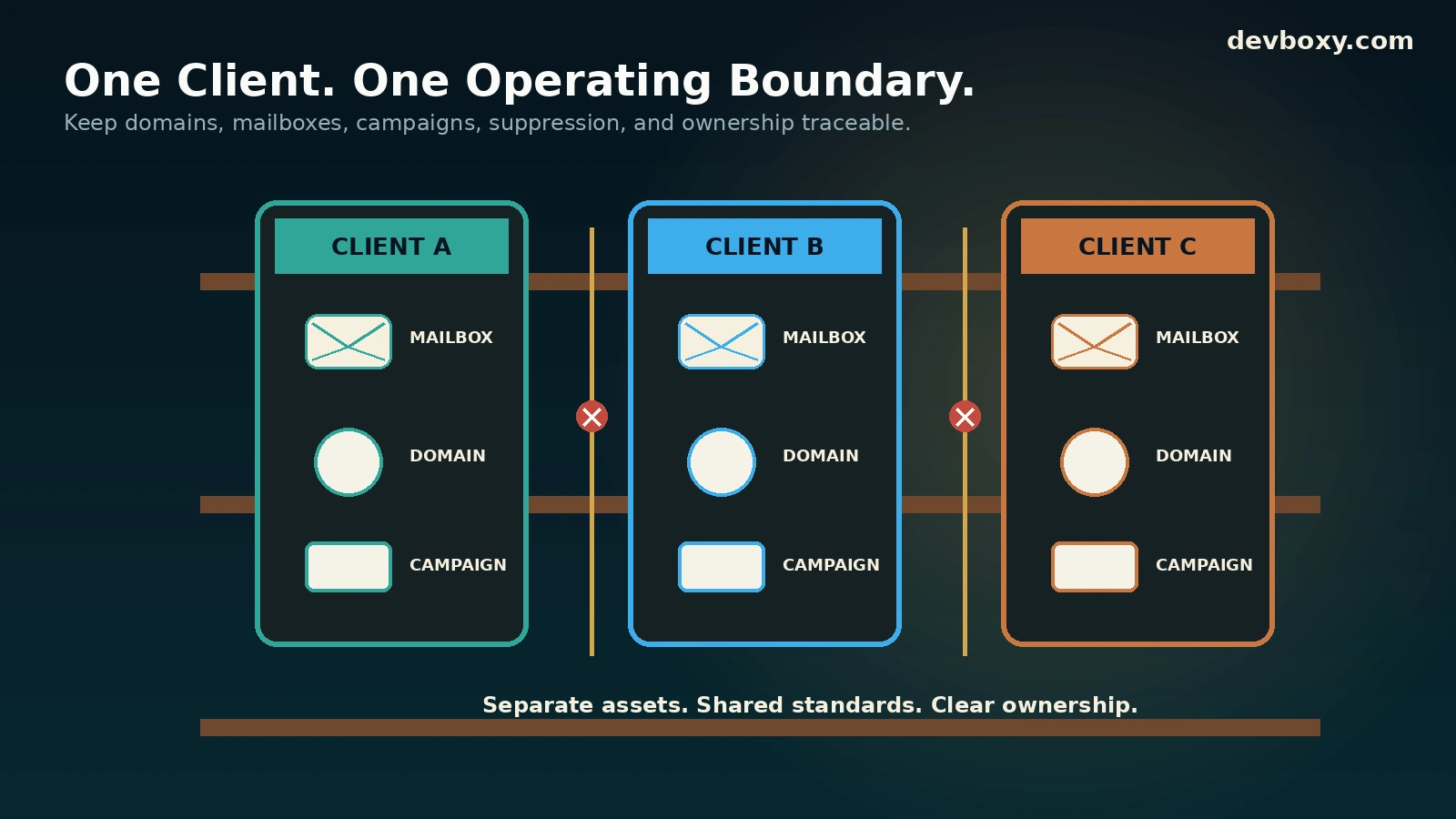
The safest default is simple: do not let one client’s data, sender assets, suppression rules, permissions, or reporting contaminate another client’s operation.
That boundary does not require one specific software architecture. It can be implemented with separate workspaces where available, or with strict client-specific campaign groups, credentials, domains, folders, roles, and naming standards. The important part is that a new operator can tell who owns an asset without guessing.
Asset | Recommended agency rule | Reason |
|---|---|---|
Sending domains | Assign to one client operating boundary | Reduces ownership confusion and makes reputation incidents easier to isolate |
Mailboxes / sender accounts | Record provider, domain, client, owner, status, and purpose | Prevents accidental reuse and exposes missing capacity |
Prospect data | Store source and client context with every import | Supports suppression, quality review, and later audit |
Campaigns | Use client-specific naming, objectives, segments, and owners | Keeps reporting and change history attributable |
Suppression | Apply client and agency-wide policies deliberately | Prevents a prior opt-out from being lost during re-import |
Reports | Generate from the same client boundary used to operate | Avoids manually reconstructing attribution after the fact |
Do not confuse separation with secrecy. The client should know which assets are theirs, what the agency controls, who pays for renewals, and what happens to domains, mailboxes, lists, and campaign history if the engagement ends.
Use a Launch Gate Instead of a Loose Handoff
Agency onboarding often fails at the transition between strategy and execution. The client approves “outbound” in principle, but the operator still lacks a final audience definition, legal review, sender ownership, exclusion rules, offer proof, or reply owner. The campaign then launches because the copy is finished rather than because the system is ready.
Create a launch gate with explicit Pass, Review, and Stop states. A client should not enter active sending until the following evidence is complete enough for the agreed scope:
campaign objective and desired first reply;
ICP, exclusions, geography, company type, and role ownership;
approved offer, claims, proof, and prohibited claims;
sender inventory and client ownership;
SPF, DKIM, DMARC, MX, and relevant tracking-domain checks;
list source, verification status, suppression reconciliation, and import QA;
sequence copy, personalization fallbacks, links, delays, and stop conditions;
reply mailbox, reply owner, backup owner, and meeting handoff;
opt-out path and durable suppression behavior;
first-batch monitoring owner and pause authority.
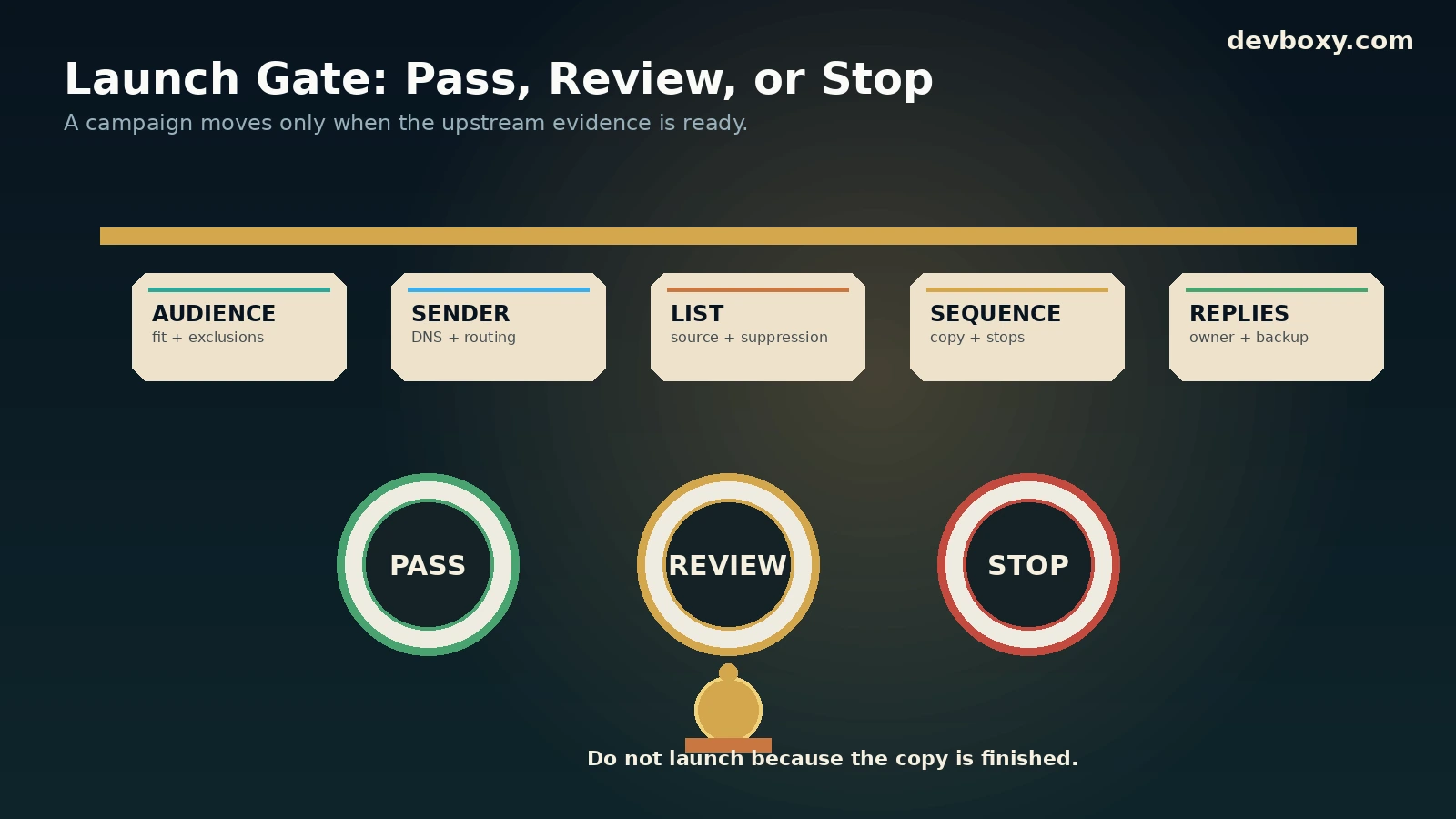
The purpose of the gate is not bureaucracy. It is to keep work from moving downstream while an upstream decision is still unresolved.
Control Infrastructure as Client-Owned Operating Assets
Domains and mailboxes are not disposable rows in a spreadsheet. They are operating assets with cost, ownership, configuration, reputation, renewal, access, and recovery history.
Maintain a client asset register with at least:
domain and registrar;
DNS provider;
mail provider;
mailbox address and sender purpose;
authentication status;
MX and reply-routing status;
warm-up or ramp state where applicable;
campaign assignment;
last health review;
owner, backup owner, and renewal responsibility;
incident or restriction history.
For public diagnostics, DevBoxy provides a Domain Health Checker, an Email DNS Checker, an MX Checker, an Email Header Analyzer, and a Blacklist Checker. Use these as evidence inputs, not as a guarantee that a sender will reach the inbox.
Google currently requires all senders to Gmail to meet baseline authentication and sending requirements, with additional requirements for senders that cross its bulk-sender threshold. Yahoo also requires authentication and low complaint rates, with stronger requirements for bulk senders. Agency policy should therefore be stricter than “the mailbox can send.” Every active sender should have a known health state and a defined reason to remain eligible.
Keep Data Quality and Suppression Ahead of Campaign Volume
Agency operators are often pressured to “use the whole list” because the client paid for the data. That is the wrong incentive. Sender capacity should be spent on contacts that are both technically usable and appropriate for the campaign.
Preserve the original source and a stable contact ID. Then apply suppression and exclusion rules before launch. Verification can help classify address quality, but it cannot tell you whether the person is the correct owner, whether the client has a defensible reason to contact them, or whether they previously asked to stop.
Use the DevBoxy Bulk Email Verifier for larger CSV or Excel lists and the single Email Verifier for one-off corrections. Keep Valid, Risky, Catch-All, Unknown, Invalid, and other results visible long enough for an operator to apply the client’s policy instead of collapsing everything into “good” and “bad.”
Every import should also reconcile against durable opt-out and suppression records. A clean file is not clean if it accidentally reactivates someone who already said no.
Standardize Campaign QA Without Standardizing the Message
Agencies need repeatable process, but the prospect should not receive a message that feels assembled by process.
Standardize the QA questions rather than forcing every client into the same copy:
Does the audience rule match the approved ICP?
Can every personalization claim be verified?
Does the offer match the problem this role can own?
Does each follow-up add a new decision input rather than restating the pitch?
Are merge-field fallbacks safe?
Do the reply mailbox and sender identity make sense together?
Will a reply, opt-out, bounce, complaint, suppression, or operator hold stop the correct future steps?
Can the team identify which sequence version created a reply?
DevBoxy publicly presents campaign creation, personalized sequences, automated follow-ups, multiple sending accounts, reply tracking, and separate outreach quotas alongside free verification. Review the live DevBoxy outreach workflow and current plan limits before designing client capacity. A plan quota is a software ceiling, not a recommended mailbox volume.
Define Roles Before the Agency Gets Busy
Good agency operations make ownership visible before a problem appears. A small team may combine several roles, but the responsibilities should still exist.
Responsibility | Primary owner | Backup / reviewer | Must be able to stop work? |
|---|---|---|---|
Client strategy and scope | Account or strategy lead | Agency lead | Yes |
Infrastructure readiness | Deliverability / technical operator | Senior operator | Yes |
List and campaign QA | Campaign operator | Strategy lead | Yes |
Positive reply handling | Assigned reply owner | Backup owner | Yes |
Reporting | Account owner | Operations lead | No, but must flag risk |
Incident response | Named incident owner | Agency lead | Yes |
Do not give every teammate every credential by default. Access should follow the work they actually need to perform. When someone leaves the agency or a client engagement ends, remove access as part of the offboarding procedure rather than as an afterthought.
Run the Agency on Daily, Weekly, and Monthly Cadences
Agency work becomes chaotic when every issue is treated as an interruption. A fixed operating cadence turns most problems into routine review and reserves urgent escalation for genuine incidents.
Cadence | Review | Typical decision |
|---|---|---|
Daily | Sender errors, bounces, deferrals, replies, opt-outs, unowned conversations, paused campaigns | Continue, hold, assign, suppress, or investigate |
Weekly | Delivery evidence, human replies, positive replies, meeting outcomes, sender distribution, segment performance | Keep, revise, narrow, or test one change |
Monthly | Domain and mailbox inventory, renewals, access, cost, client capacity, repeated incidents, reporting quality | Replace, retire, expand, consolidate, or change process |
Quarterly / contract milestone | Offer fit, ICP, economics, client goals, infrastructure model, continuation | Renew, reposition, resize, or stop the program |
Daily reviews should be short and operational. Weekly reviews should connect performance to one or two decisions. Monthly reviews should challenge whether the system itself remains healthy.
Build a Reply Handoff That Cannot Drift
A positive reply is not a result until someone owns the next action. Agencies lose opportunities when replies sit in the wrong mailbox, get forwarded without context, or are answered by two people at once.
For every client, define:
which inboxes can receive replies;
how replies are detected and associated with a campaign;
which replies stop automation immediately;
how positive, neutral, negative, referral, timing, out-of-office, and opt-out replies are recorded;
who responds to each category;
who owns after-hours or absence coverage;
what counts as a completed handoff;
how a booked meeting is associated with the original client, campaign, and prospect.
The safest default after a human reply is to stop remaining automated follow-ups first and classify second. An unclear classifier should create review work, not permission to continue sending over an active conversation.
Report Decisions, Not Activity
Clients do not need a spreadsheet full of numbers they cannot interpret. They need a concise explanation of what happened, what it means, and what the agency will do next.
A useful weekly client report can contain five blocks:
System health: sender restrictions, authentication issues, bounce or complaint anomalies, and major pauses.
Conversation outcomes: unique human replies, positive replies, relevant objections, referrals, and opt-outs.
Business outcomes: meetings held or other client-defined qualified actions—not only meetings booked.
What changed: segment, copy, offer, sender allocation, list source, or cadence changes.
Next action: one or two decisions with owner and due date.
Do not hide weak results behind volume. If 10,000 sends created the same number of useful conversations as a smaller prior cohort, volume is not automatically progress. Report the denominator, absolute counts, and the material change that may explain the result.
Use Change Control for Anything That Can Distort Results
Cold email systems are sensitive to changes that seem small in isolation. A new list vendor, broader ICP, different sender provider, subject-line rewrite, extra follow-up, or increased volume can all alter the evidence.
Keep a lightweight change log with:
date and client;
what changed;
who approved it;
which campaign or sender cohort is affected;
expected reason for the change;
what metric or outcome will be reviewed;
the rollback or stop condition.
Without change control, the agency cannot tell whether a result came from the offer, the audience, the sending layer, or several changes made at once.
Give Incidents an Owner and a Stop Authority
Every agency eventually sees a domain restriction, provider rejection, spike in bounces, complaint cluster, lost reply, broken personalization field, or campaign that should have stopped but did not. The difference between a nuisance and a client crisis is usually how quickly the operation can isolate and control the problem.
Define incident severity before incidents occur. At minimum, document who can:
pause one campaign;
pause one sender;
remove a client segment;
suppress a contact or domain;
disable a broken template or automation;
notify the client;
approve a safe restart.
Do not keep sending while the team debates ownership. Protect the channel first, preserve evidence, then diagnose the cause.
Make Compliance a Shared Operating Responsibility
Agency contracts do not remove legal or provider responsibilities. In the United States, the FTC explains that CAN-SPAM applies to commercial email, including B2B messages, and that a company cannot simply contract away responsibility when another company sends marketing on its behalf. Both the promoted business and the sender can carry responsibility.
The UK rules differ by subscriber type. The ICO currently distinguishes corporate subscribers from individual subscribers such as sole traders and some partnerships, and it requires sender identity and a valid opt-out address in the situations described by its guidance. The ICO also advises organisations to perform appropriate checks on companies sending marketing for them and to use written contracts that set responsibilities.
Provider policy is a separate layer. Review the current Google email sender guidelines and Yahoo Sender Hub requirements. Google and Yahoo both emphasize authentication and low complaint rates, with additional requirements for bulk senders. The FTC CAN-SPAM guide and ICO B2B marketing guidance should be part of the agency’s jurisdiction-specific review, not copied into one universal rule for every client.
This section is operational information, not legal advice. Agencies working across jurisdictions should obtain qualified guidance for the audiences and message types they handle.
Track Capacity and Margin Before You Add Clients
Agency scale is not the number of mailboxes connected. It is the amount of client work the team can operate without losing control.
Model capacity around workload drivers:
active clients;
active domains and senders;
list volume and import frequency;
campaigns and variants under active review;
reply volume and handoff complexity;
technical incidents and DNS work;
reporting and client meeting load;
vendor and mailbox cost;
operator hours required per client.
A client is not profitable because infrastructure is cheap. A client is profitable when the service can be delivered with reliable process, reasonable human attention, and enough margin to absorb troubleshooting and review.
Do not automate a process the agency cannot explain manually. Automation should reduce repetitive work after the decision logic is stable, not hide a fragile operation behind more volume.
How DevBoxy Fits Into an Agency Operating Model
DevBoxy currently presents a combined workflow for email verification, campaign creation, multiple sending accounts, sequences, automated follow-ups, reply tracking, and deliverability diagnostics. The public network tools also provide checks for authentication, routing, tracking domains, headers, connectivity, and common blocklists.
A practical agency workflow in DevBoxy can be organized around the same operating principles:
preserve a client-specific boundary for contacts, campaigns, sender assets, and reporting;
verify contact data before campaign eligibility decisions;
check sender domains and mail routing before launch;
configure only the sequence steps justified by the client’s audience and offer;
keep reply and stop conditions authoritative;
review campaign evidence before increasing scope or volume;
keep plan limits, provider policy, and sender health separate from one another.
DevBoxy can support the operating layer, but the agency still owns client boundaries, legal review, list sourcing, campaign relevance, approvals, response quality, and the decision to stop.
A 30-Day Plan to Install the Agency Operating System
If your agency currently runs on memory and chat, do not redesign everything at once. Install the control points in order.
Week 1: Inventory and ownership
Create one client asset register. Map domains, mailboxes, campaigns, lists, suppressions, reply routes, credentials, owners, and renewals. Mark anything with unclear ownership as Review.
Week 2: Launch and change control
Create the launch gate, naming standard, campaign QA checklist, and change log. Stop approving material campaign changes in private messages that nobody else can reconstruct.
Week 3: Reply and incident operations
Define reply categories, owners, backup coverage, meeting handoff, stop-on-reply expectations, incident severity, pause authority, and restart approval.
Week 4: Reporting and capacity
Standardize daily checks, weekly client reports, monthly asset review, and a basic capacity model based on active client workload rather than vanity mailbox count.
At the end of 30 days, test the system with a simple exercise: pick one prospect from one client and reconstruct the complete path from source to sender to campaign to reply to outcome. Then pick one active domain and reconstruct its owner, DNS evidence, mailbox assignments, campaigns, incidents, and renewal responsibility. Any missing link is the next operating problem to fix.
Build the Agency So Good Results Do Not Depend on Memory
The goal of agency operations is not to remove judgment. It is to make good judgment repeatable.
Keep clients separated. Preserve evidence. Assign owners before launch. Treat sender assets as infrastructure, not expendable inventory. Keep list quality and suppression ahead of volume. Stop automation when the conversation changes. Report decisions instead of activity. Log important changes. Give incidents an owner. Review the system on a fixed cadence.
Once those controls exist, adding clients becomes a capacity decision rather than a gamble. That is the point where an outbound agency can scale without turning every new account into more operational debt.
Frequently asked questions
What does cold email agency operations mean?
Cold email agency operations is the operating system used to manage outbound work across multiple clients. It covers client boundaries, sender assets, list and campaign QA, reply ownership, reporting, permissions, change control, compliance, incident handling, and capacity planning.
Should an agency separate domains and mailboxes for every client?
The safest operating model is to keep each client inside a clearly defined boundary so domains, sender accounts, campaigns, data, suppressions, and reporting are not mixed. The exact technical implementation can vary by platform, but ownership and isolation should always be unambiguous.
What should a cold email agency check every day?
Daily operations should focus on sender errors, bounces, temporary deferrals, new replies, opt-outs, unowned conversations, campaign pauses, broken personalization, and anything that requires an immediate hold or owner assignment. Broader performance analysis belongs in the weekly review.
Which metrics should a cold email agency report to clients?
Report the metrics that support decisions: sender and delivery issues, unique human replies, positive replies, meaningful objections, opt-outs, meetings held or other qualified outcomes, and material campaign changes. Show absolute counts and denominators so clients can interpret percentages correctly.
How should an agency handle opt-outs across client campaigns?
Opt-outs should become durable suppression records before another automated send can occur. Reconcile new imports against existing suppressions, preserve the reason and date, and make client-specific versus agency-wide suppression policy explicit instead of allowing re-imports to reactivate contacts.
How can DevBoxy support cold email agency operations?
DevBoxy currently presents email verification, multiple sending accounts, campaign creation, sequences, automated follow-ups, reply tracking, outreach analytics, and public DNS and deliverability diagnostics. Agencies still own client isolation, legal review, list sourcing, campaign relevance, approvals, response quality, and the decision to pause or stop.