Founders usually do not need a large outbound stack. They need a small system they can understand end to end.
That means knowing why a prospect is on the list, whether the address is usable, which mailbox will send, what the first message is trying to learn, when a follow-up should stop, and who will answer when someone replies. A founder can run all of those steps alone at first. The danger begins when the tools and sending volume grow faster than the operating discipline.
This guide explains a lean cold email setup for founders and small teams: the minimum viable stack, a practical cost and capacity model, list and sender controls, founder-led message design, reply ownership, and the point where the workflow should become a team system. It is not a guide to maximizing volume. It is a guide to building enough control to learn without creating unnecessary cost or reputation risk.
Key Takeaways
Start with one clear market hypothesis, one sender identity, one reply owner, and one measurable business outcome.
Use the smallest tool stack that can still preserve list quality, sender health, campaign state, replies, suppressions, and decisions.
Software quota is not a safe sending recommendation. Provider policy, sender history, audience quality, and your ability to monitor replies should set the real operating limit.
Founder-led outreach works best when the reply path is real: if the email comes from the founder, the founder or a clearly introduced teammate should own the conversation.
Keep list quality, ICP quality, and contact eligibility separate. A valid mailbox can still be the wrong person or a suppressed contact.
Automate mechanics before judgment. Do not automate positioning, questionable personalization, or ambiguous replies simply because software allows it.
Move to a team operating model when handoffs, mailbox count, response coverage, or reporting become too complex for one person to manage reliably.
Start With One Founder-Led Outbound Hypothesis
Early outbound is most useful when it answers a real business question. A founder should be able to finish this sentence before importing a list:
We believe [specific buyer] at [specific company type] has [specific problem], and a useful first outcome is [specific response or next step].
That statement creates an operating boundary. It tells you which accounts belong in the campaign, what evidence to collect, what message to write, and what counts as progress.
A weak hypothesis sounds like “we sell automation to small businesses.” A stronger one sounds like “we help independent recruiting firms with 5–25 staff reduce the manual work of routing candidate replies across multiple inboxes.” The second version is narrow enough to build a list and learn from the replies.
Do not confuse a market with an ICP
“SaaS,” “agencies,” “ecommerce,” and “startups” are markets. A useful founder ICP also includes ownership, problem context, exclusions, and timing. Keep the first campaign deliberately small enough that you can read every reply and understand why the contact was selected.
Build the Leanest Stack That Can Still Be Controlled
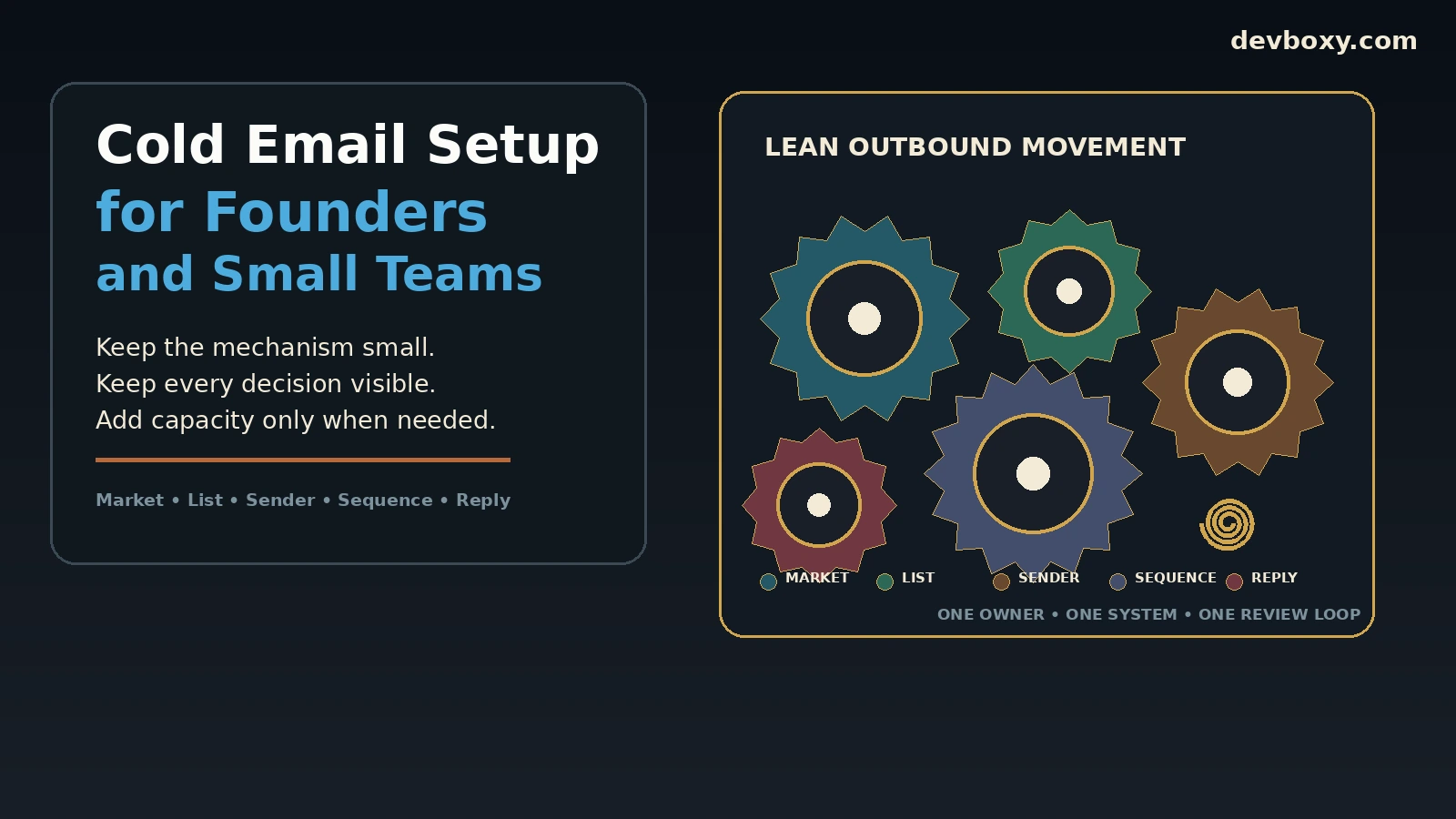
A founder stack can be simple without being sloppy. The minimum viable system has five operating parts:
Layer | What it must preserve | Founder question |
|---|---|---|
Market and contact data | Account reason, contact role, source, stable ID, exclusions | Why is this person on the list? |
Verification and suppression | Address status, uncertainty, opt-outs, previous failures | Is this contact both usable and eligible? |
Sender infrastructure | Mailbox, domain, authentication, routing, sender history | Can this sender transmit and receive responsibly? |
Campaign and follow-ups | Message, sequence, delay, personalization, stop conditions | What changes in each step? |
Replies and decisions | Owner, classification, next action, outcome | Who acts when the prospect answers? |
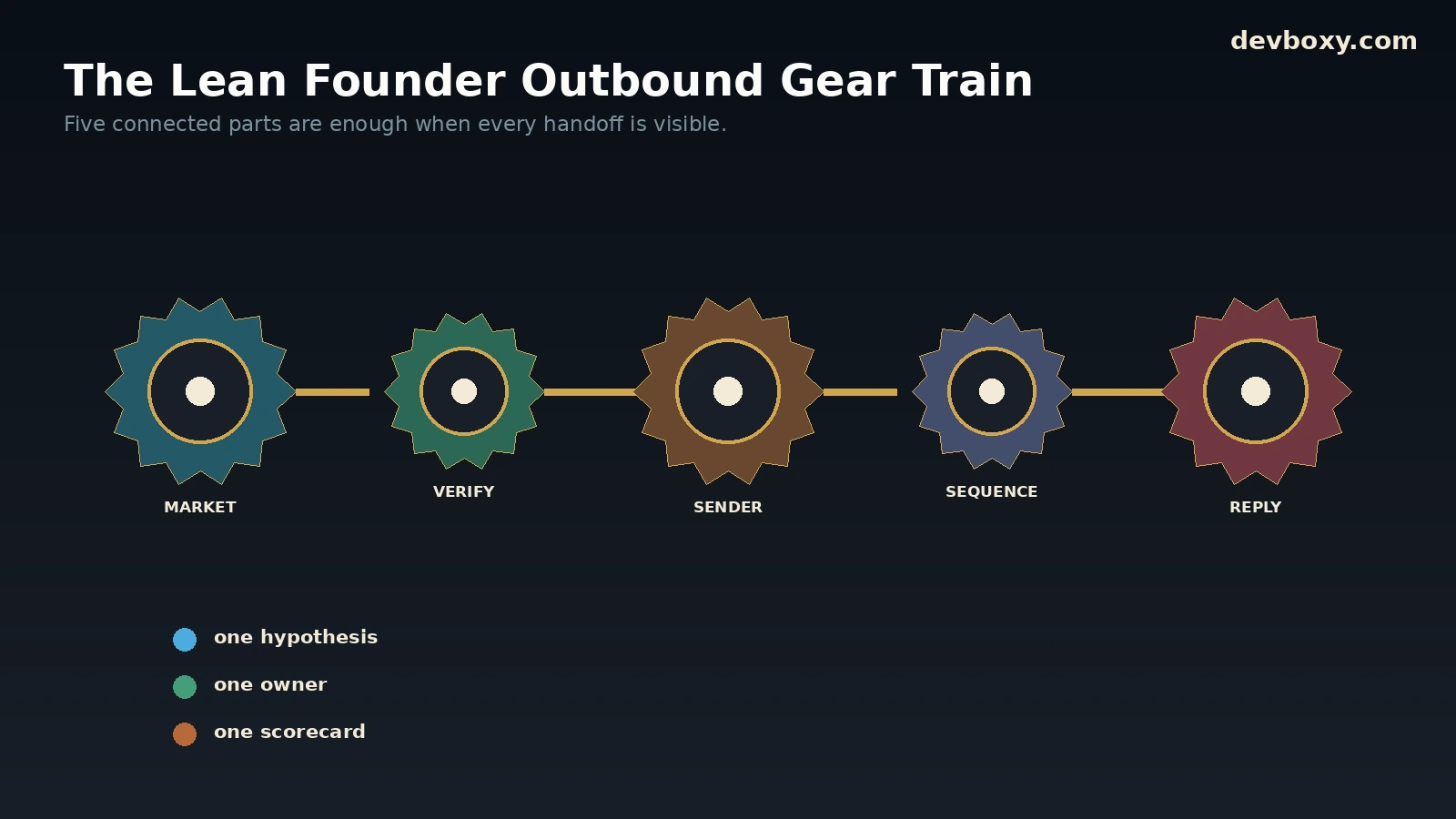
DevBoxy’s current public homepage presents email verification, campaign creation, contact management, sequences, follow-ups, reply tracking, and deliverability tools in one workflow. That makes it possible to keep a small founder stack consolidated rather than stitching together separate tools too early. Review the current DevBoxy outreach workflow and use the network and deliverability tools when setting up sending infrastructure.
Use a Lean Cost and Capacity Model
Founders often overspend on outbound because they buy capacity before they have evidence that the message, ICP, or process works. A better model starts with the smallest plan that can support the current learning stage.
DevBoxy’s current public pricing page lists the following software plans and quotas:
Plan | Monthly price | Campaigns | Emails/day quota | Contacts | Follow-up steps | SMTP credentials |
|---|---|---|---|---|---|---|
Free | $0 | 3 | 50 | 250 | — | 1 |
Basic | $8 | 20 | 300 | 2,000 | 2 | 3 |
Pro | $15 | 75 | 1,500 | 15,000 | 4 | 10 |
Business | $25 | 250 | 5,000 | 75,000 | 6 | 25 |
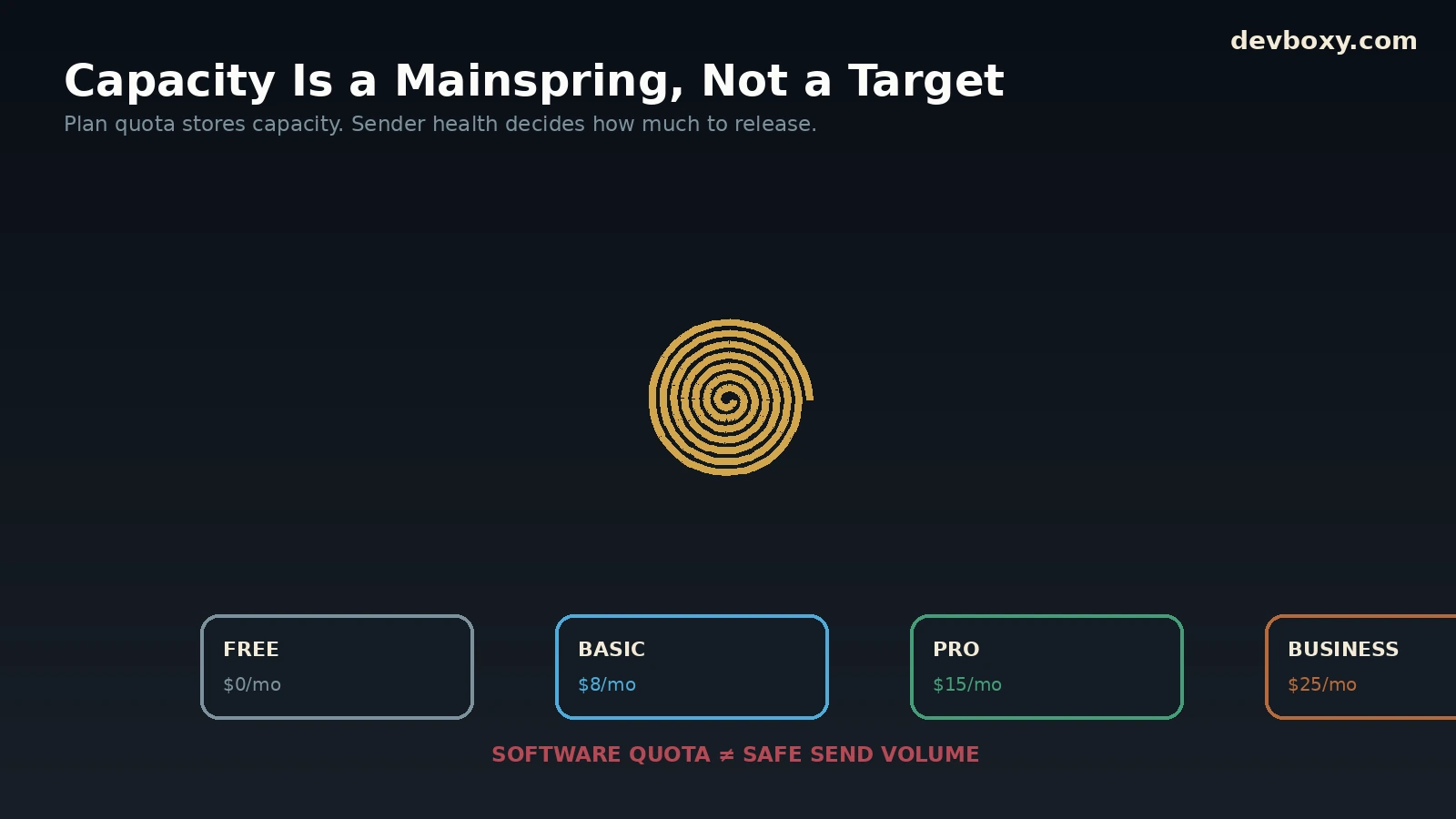
These are software entitlements, not safe sending recommendations. A Free or Basic plan can be enough to validate a narrow outbound motion. A larger plan is useful only when the market, message, reply workflow, sender health, and team capacity justify the extra quota.
The current DevBoxy pricing page should be rechecked before publication because prices and quotas can change. Also budget separately for sender accounts, domains, enrichment or data sources, CRM software if used, and the founder’s time. The cheapest software stack is still expensive if the list is wrong or the founder cannot respond to interested prospects.
Separate Software Capacity From Sender Safety
The most important capacity rule for a small team is simple: do not send at a plan limit just because the plan allows it.
Google’s current email sender guidelines require all senders to personal Gmail accounts to meet authentication, DNS, TLS, formatting, and spam-rate requirements. Google’s current sender FAQ also explains that traffic from the same primary domain is aggregated for bulk-sender classification and that bulk-sender status does not expire once assigned.
Yahoo’s current sender requirements require SPF or DKIM for all senders, low complaint rates, valid forward and reverse DNS, RFC compliance, and additional SPF, DKIM, DMARC, alignment, and unsubscribe controls for bulk senders.
For a founder, the practical implication is to ramp from evidence. Watch hard bounces, temporary deferrals, authentication failures, complaint signals where available, opt-outs, and the quality of actual replies. Increase volume only when the previous level is healthy and the team can still respond promptly.
Verify the List Without Pretending Verification Proves Fit
Founders need to protect two scarce resources: sender reputation and attention. A poor list wastes both.
Use the DevBoxy Email Verifier for individual checks and the Bulk Email Verifier for CSV or Excel lists. Current DevBoxy pages distinguish valid, risky, invalid, catch-all, temporary, unknown, and other uncertain outcomes rather than treating every address as a simple yes or no.
Keep three separate decisions:
ICP fit: should this company and person be targeted?
Address quality: what does verification evidence say about the mailbox?
Eligibility: has the person opted out, bounced permanently, complained, or otherwise become ineligible?
A technically valid address can still be the wrong buyer. A perfect ICP contact can still be suppressed. A catch-all result can require review rather than automatic inclusion or exclusion.
Authenticate the Sender Before the Founder Starts Testing Copy
Founders often spend hours rewriting copy while the sending domain still has incomplete DNS or an untested reply path. Fix the infrastructure first.
Use the Email DNS Checker to review SPF, DKIM, DMARC, and MX together, and the Domain Health Checker for a broader pre-launch view. Then send a real controlled test and inspect the message headers, reply routing, From identity, and authentication result.
Do not use domains or headers that disguise who is sending. DevBoxy’s current Terms of Service prohibit deceptive campaigns, hiding sender identity, bypassing opt-outs, and using data without the required rights or lawful basis.
Founder-Led Messaging Should Sound Like the Founder
The founder advantage is not title prestige. It is direct access to product knowledge, customer context, and the reason the company exists. Use that advantage.
A founder-led email should usually be:
short enough to read without opening another document;
specific about why the account or buyer belongs in the conversation;
honest about what the product does and does not solve;
clear about the smallest useful next step;
written in language the founder would actually use on a call.
Hi {{firstName}},
I noticed {{companyName}} is adding a second operations manager. We built {{productName}} for small teams that are starting to lose handoff context between email, spreadsheets, and their CRM.
I’m still close to the product and would rather learn whether this is a real problem for you than send a generic demo pitch.
Is that handoff becoming painful yet, or not really?
{{founderName}}
The point is not to announce “I’m the founder.” The point is to make the conversation credible and easy to answer.
Use a Small Sequence With Distinct Jobs
A founder should not compensate for a weak first email by adding many follow-ups. Use the smallest sequence that can test a few reasonable explanations for silence.
Step | Job | Founder question |
|---|---|---|
Initial | Establish relevance | Why should this person care? |
Follow-up 1 | Clarify the mechanism or problem | What did I leave unclear? |
Follow-up 2 | Add proof or a useful example | What evidence would help them evaluate this? |
Final | Route or close | Is there a better owner, later time, or no fit? |
Use automation for delays and eligibility checks, not for judgment. A scheduled follow-up should still verify that the contact has not replied, opted out, bounced permanently, been suppressed, or entered a manual hold.
Keep the Reply Path Real
Founder-led outbound creates an expectation: the reply should reach someone who understands the product and the context. Do not send from the founder and then route the prospect into an unrelated scheduling machine without explanation.
For a founder-only team, the owner is obvious. For a small team, define a simple handoff:
Reply type | Immediate action | Likely owner |
|---|---|---|
Interested | Respond in context and agree the next step | Founder or sales owner |
Needs detail | Answer the question before asking for a meeting | Founder / product owner |
Wrong person | Ask for the correct owner and update the account | Founder / operator |
Not now | Stop the sequence and record the approved future timing | Campaign owner |
Opt-out | Apply durable suppression | System + owner |
Stop remaining automated follow-ups when a human reply arrives, then classify and route the conversation. That is safer than keeping automation active while the team decides whether the reply is positive.
Review One Small Scorecard Every Week
Founders do not need twenty charts. They need enough evidence to make the next decision.
Review:
eligible accounts and contacts;
accepted sends, hard bounces, and temporary deferrals;
unique human replies and positive replies;
wrong-person, timing, objection, and opt-out responses;
meetings held or another agreed business outcome;
which list source, buyer type, message, or sender created the result;
one change to test next.
Do not let open rate run the program. Opens can be distorted by privacy features, proxies, prefetching, and security tools. Use replies and downstream outcomes as the main evidence.
Protect Opt-Outs and Basic Compliance From Day One
A small team does not get a compliance exemption because the campaign is small. Rules vary by jurisdiction, recipient, message purpose, and data source, so obtain qualified guidance for the markets you contact.
In the United States, the FTC’s CAN-SPAM compliance guide applies to commercial email, including B2B email. It requires accurate headers and subject lines, a valid postal address, a clear opt-out mechanism, and honoring opt-out requests within the required period.
Your internal system should stop faster than the outer legal deadline. Preserve suppression across CSV imports, campaign copies, sender changes, and team handoffs. Review DevBoxy’s current Privacy Policy and Acceptable Use Policy before uploading or processing prospect data.
Know When Founder-Led Outbound Should Become a Team System
Founder-led outbound stops scaling cleanly before the founder necessarily stops writing emails. The transition point appears when the operating work can no longer be held reliably in one person’s head.
Move toward a team model when:
multiple mailboxes or domains need regular health monitoring;
reply coverage is inconsistent across time zones or workdays;
interested prospects wait because the founder is unavailable;
campaign changes are made without a clear record;
list sourcing, verification, sending, and replies are owned by different people;
the team needs consistent reporting across campaigns;
permissions and client or workspace boundaries matter;
the founder wants to stay involved in high-value conversations without running every operational step.
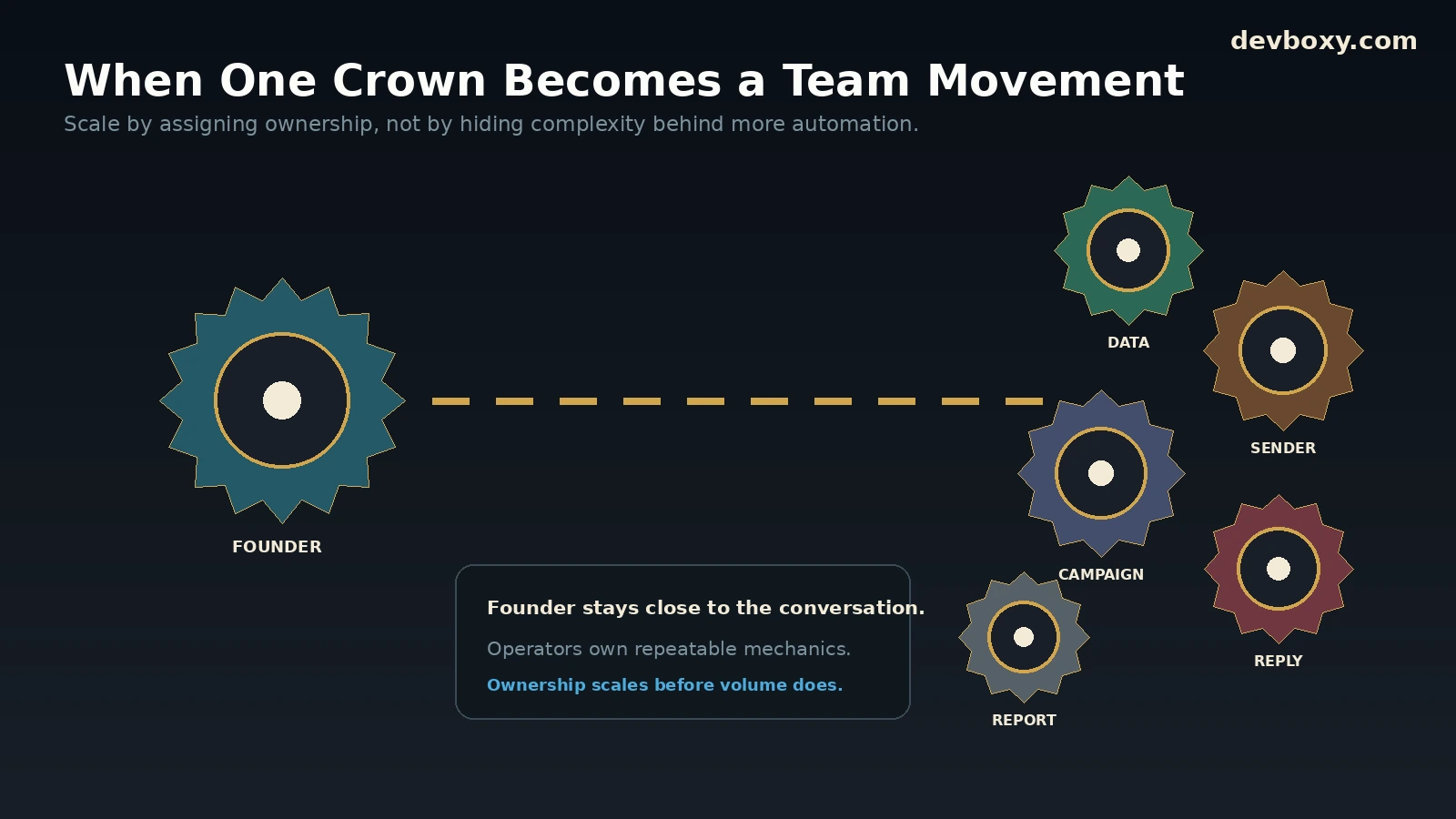
The next stage is not “more automation.” It is clearer ownership. One person may own data, another sender health, another campaign execution, and another sales follow-up. The founder can remain the voice or executive sponsor without becoming the bottleneck.
A Practical Founder Setup in DevBoxy
Define one ICP hypothesis, one primary offer, and one useful first-reply outcome.
Build a narrow account and contact list with source and role evidence.
Use the bulk verification workflow and keep uncertain statuses visible.
Connect the sender and review authentication with the Email DNS Checker.
Use the Domain Health Checker before launch and when sender behavior changes.
Create one campaign with a short first email and a small number of distinct follow-up jobs.
Set stop conditions and make the founder or named teammate the reply owner.
Launch a controlled cohort rather than exposing the full list.
Review replies and business outcomes weekly, then change one variable at a time.
Upgrade software capacity only when the operating evidence—not impatience—justifies it.
DevBoxy can keep verification, campaigns, follow-ups, reply tracking, and diagnostics connected. The founder still owns the harder decisions: market fit, relevance, proof, legality, and whether a real person should receive another message.
Small Teams Win by Keeping the System Understandable
A founder does not need enterprise complexity to run professional outbound. The goal is to keep the system small enough to understand and strong enough to control.
Start with one market hypothesis. Build a clean list. Authenticate the sender. Use a short sequence. Preserve opt-outs. Answer real replies quickly. Review one scorecard. Then add capacity only when you can explain what the extra capacity is supposed to accomplish.
That is a better foundation than buying a large stack first and hoping volume will reveal the strategy later.
Frequently asked questions
What is the simplest cold email setup for a founder?
Start with one clear ICP hypothesis, one sender identity, one connected mailbox, a verified and suppression-checked list, one campaign, a small sequence, and one reply owner. Add tools only when they solve a real operating problem you can already describe.
How much does a lean founder cold email setup cost in DevBoxy?
DevBoxy currently lists a Free plan at $0, Basic at $8 per month, Pro at $15, and Business at $25. Those prices cover software capacity only; domains, sender accounts, data sources, CRM software, and founder time can create additional cost. Recheck live pricing before purchase or publication.
How many cold emails should a founder send per day?
There is no universal safe number. Do not use a software quota as the target. Base sending on provider rules, authentication, sender history, list quality, recipient feedback, and your ability to monitor and answer replies. Increase gradually only when the previous level is healthy.
Should founders send cold emails from their own mailbox?
A founder can send from a legitimate founder-owned business mailbox when the identity, domain, authentication, reply routing, and compliance setup are appropriate. The important point is that the reply path should be real and the founder or a clearly introduced teammate should own the conversation.
When should a founder hire an SDR or outbound operator?
Consider a team handoff when reply coverage becomes inconsistent, multiple mailboxes or domains need monitoring, campaigns change without documentation, interested prospects wait for the founder, or data, sending, replies, and reporting need separate owners. The trigger is operational complexity, not a specific number of emails.
How does DevBoxy support founders and small teams?
DevBoxy currently presents email verification, campaign creation, contact management, multiple sending accounts, sequences, automated follow-ups, reply tracking, pricing-based quotas, and network and deliverability diagnostics. The founder still owns market fit, list sourcing, compliance, sender safety, messaging quality, and reply decisions.