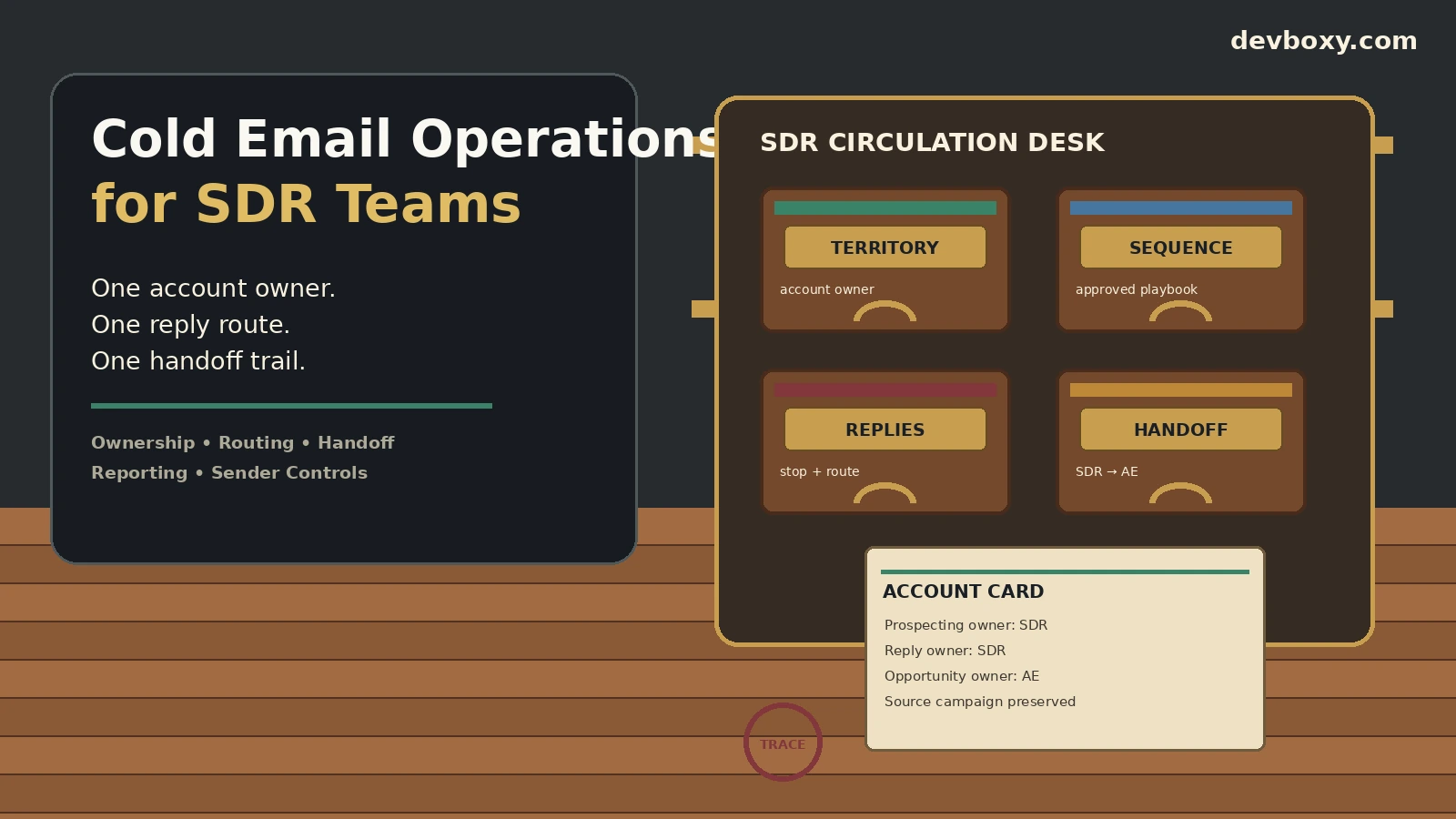
A strong SDR team does not need every rep to invent a different prospecting system. It needs one operating model that makes ownership, sequence logic, sender capacity, replies, handoffs, and reporting visible enough that the team can move quickly without creating collisions.
That is the difference between running cold email as a collection of rep activities and running cold email operations for SDR teams. The first approach measures how busy people are. The second can explain who owns each account, why a prospect entered a sequence, which sender was used, what happened after the reply, whether the AE accepted the handoff, and which parts of the system should change next.
This guide focuses on that operating layer. It does not own the broad SaaS ICP and messaging strategy, founder-led setup, or general agency operations. It owns the team structure behind SDR cold email: territory and account ownership, sequence governance, sender assignment, reply routing, SDR-to-AE handoff, attribution, and performance reporting.
Key Takeaways
Define ownership before volume. Every account, contact, sequence, sender, reply, and opportunity should have an authoritative owner or routing rule.
Separate account ownership from activity attribution. An SDR can deserve credit for the prospecting work even after an AE becomes the opportunity owner.
Standardize the parts that protect quality—eligibility, suppression, sequence purpose, sender rules, stop conditions, handoff fields, and reporting definitions—while leaving room for rep judgment inside the message.
Stop automated follow-ups when a human reply arrives, then classify and route the conversation. A scheduled step is never more important than an active reply.
Report the funnel from eligible accounts to accepted opportunities. Activity counts matter for capacity, but they should not become the primary definition of SDR performance.
Use provider rules and sender evidence to control volume. Software quota is capacity, not permission to send at the maximum.
Preserve the complete handoff context so the AE can continue the conversation without forcing the prospect to repeat themselves.
Cold Email Operations Starts With Clear Role Boundaries
Many SDR teams create friction because four different ownership concepts are collapsed into one CRM field. The person researching the account, the person sending the message, the person answering the reply, and the person owning the opportunity are not always the same.
A workable operating model distinguishes at least these roles:
Role | Primary responsibility | When ownership changes |
|---|---|---|
SDR / BDR | Research, prospecting, sequencing, first reply qualification, meeting preparation | Usually retains activity attribution after handoff |
AE | Discovery, evaluation, commercial process, opportunity progression | Takes deal ownership at the agreed qualification boundary |
SDR manager | Coverage, coaching, capacity, sequence quality, rep-level operating consistency | Escalates when ownership or performance rules fail |
RevOps / Sales Ops | Data model, routing, suppression, attribution, reporting definitions, tooling governance | Owns system rules rather than individual prospect conversations |
HubSpot’s current enterprise prospecting guidance recommends clear ownership between SDRs and AEs, with SDRs handling initial research and outreach, AEs taking over once a meaningful conversation is established, and both teams working from a shared record of activity, response, and next action. That operating principle matters even when your CRM or sales-engagement tool uses different object names.
Use an Ownership Model That Survives the Handoff
A clean SDR process needs more than “contact owner.” Define the operating fields that must remain visible throughout the funnel.
Field | Why it exists | Example rule |
|---|---|---|
Account owner | Prevents two reps from prospecting the same account independently | One active SDR owner per account or approved pod |
Prospecting owner | Preserves credit for the SDR who sourced and worked the contact | Does not disappear when the AE takes the opportunity |
Sender owner | Explains which rep or sender pool is responsible for the outbound identity | Mapped before enrollment |
Reply owner | Ensures a human response has a named next action | Defaults to SDR until qualification threshold is met |
Opportunity owner | Defines who runs the commercial process | Usually the AE after accepted qualification |
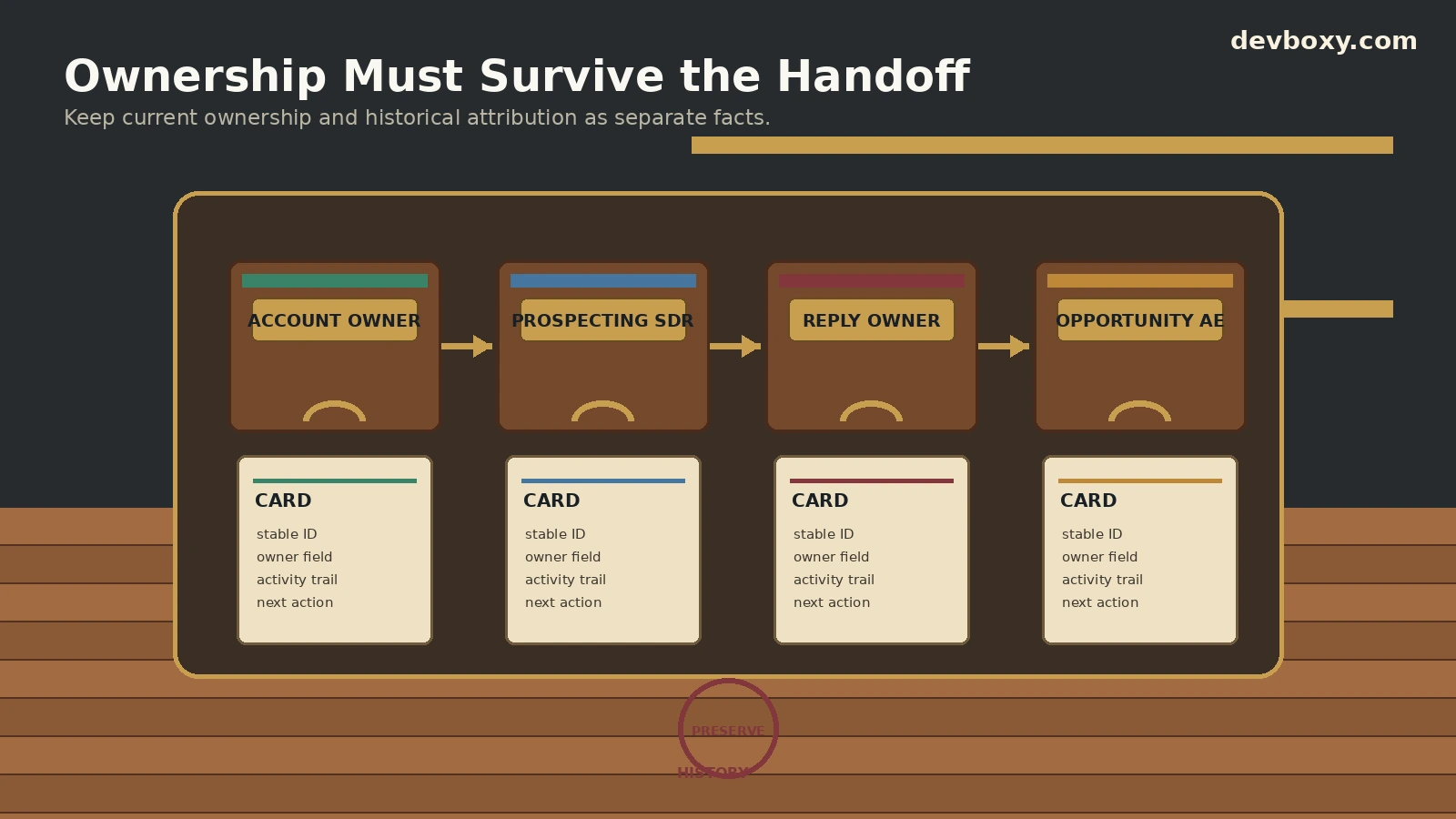
The practical goal is continuity. A rep leaving the company, an account moving territory, or an AE taking over should not erase who did the prospecting work or why the prospect was contacted.
Do not transfer ownership by deleting history
When an account moves from SDR to AE, preserve the SDR attribution in a stable field or event record. The AE can become opportunity owner without rewriting the historical prospecting owner. This makes coaching, compensation, and source reporting more reliable.
Design Territories to Prevent Collision, Not Just to Divide Volume
Territories are often treated as a quota-planning exercise. For cold email operations, they are also a collision-control system.
A territory can be based on geography, account segment, industry, named accounts, product line, language, or a combination. Whatever model you use, the assignment must answer:
Which SDR can prospect this account?
Can more than one SDR work the account at the same time?
What happens when two contacts at the same company enter different campaigns?
How are parent and subsidiary accounts handled?
When does inactivity release the account?
Who approves exceptions?
Apollo’s current SDR territory guidance emphasizes maintaining current ownership fields and rebalancing account coverage rather than leaving stale ownership in place. The exact review frequency depends on your team and market, but the principle is sound: territory state must be maintained, not configured once and forgotten.
Standardize Sequence Governance Without Making Every Rep Sound the Same
SDR teams need consistency, but copy-paste uniformity can destroy relevance. Standardize the framework rather than forcing identical prose.
The team should centrally define:
which ICP and campaign purpose a sequence serves;
which contacts are eligible or excluded;
the job of each sequence step;
approved proof and claims;
personalization variables and safe fallbacks;
follow-up and stop rules;
the sender pool and capacity policy;
reply categories and handoff rules;
the test currently running.
Then let the SDR personalize real observations, role context, examples, and questions where appropriate.
HubSpot’s current Sales Hub documentation supports sharing or restricting sequences, templates, playbooks, and other sales content by users or teams. Salesloft similarly presents shared team cadences and campaign reporting. The tooling differs, but the operating lesson is the same: central governance should make approved content easy to use and unapproved drift easy to see.
Separate Data Eligibility From Rep Preference
An SDR should not decide whether a contact is eligible based only on whether the account looks interesting. Before sequence enrollment, the system should evaluate at least four different questions:
Account fit: does the company belong in the campaign?
Contact fit: does the person own or influence the problem?
Address quality: what does verification say about the email address?
Eligibility: has the contact opted out, bounced permanently, complained, or otherwise become ineligible?
Use the DevBoxy Bulk Email Verifier for list-level checks and the single Email Verifier for one-off review. DevBoxy’s current public workflow distinguishes valid, invalid, risky, catch-all, disposable, and unknown results. Keep those meanings visible rather than flattening every uncertain contact into “safe” or “bad.”
Verification does not override suppression. A technically valid address that opted out remains ineligible. A catch-all address may still deserve human review. A valid address for the wrong persona is still the wrong lead.
Assign Sender Capacity as a Team Resource
SDR teams create reputation risk when each rep treats their connected mailbox as an independent volume allowance. Provider systems see the sending domain, authentication, traffic pattern, complaint behavior, and related infrastructure—not your org chart.
Define sender policy at team level:
which mailboxes belong to which SDRs or pools;
which campaigns can use each sender group;
what minimum delay and pacing rules apply;
what evidence pauses a mailbox;
how new senders are introduced gradually;
how a rep handoff affects the From identity and reply path.
Google’s current email sender guidelines require SPF or DKIM for all senders to personal Gmail accounts, valid forward and reverse DNS, TLS, RFC-compliant message formatting, and controlled spam rates. Senders crossing Google’s bulk threshold must meet additional SPF, DKIM, DMARC, alignment, and unsubscribe requirements. Google’s related FAQ also explains that mail from subdomains can count toward the same primary-domain bulk-sender classification.
Yahoo’s current Sender Hub guidance similarly emphasizes authentication, complaint control, standards compliance, easy unsubscribe for applicable promotional traffic, and avoiding sudden traffic spikes.
Use the DevBoxy Email DNS Checker for SPF, DKIM, DMARC, and MX review, and the Domain Health Checker for a broader pre-launch and monitoring view. When a narrower diagnostic is needed, use the SPF Checker, DKIM Checker, DMARC Checker, or MX Checker.
Make Reply Routing Authoritative
A real reply changes the state of the campaign. The safe operating order is:
detect the inbound message;
stop the remaining automated follow-ups;
classify the response;
assign the next human owner;
write the next action back to the prospect record;
update suppression or future timing where required.
Apollo’s current follow-up guidance warns against repeated messages and emphasizes deliberate follow-ups with distinct value and a clear stop rule. For team operations, that stop rule must be enforced by the system rather than depending on the rep remembering to pause a sequence manually.
Reply state | Automation action | Human route |
|---|---|---|
Positive interest | Stop | SDR responds or hands to AE under the qualification rule |
Needs information | Stop | Answer the question before pushing for a meeting |
Wrong person / referral | Stop current path | Update account map and contact the approved owner |
Not now | Stop | Record future timing only when appropriate |
Opt-out | Stop permanently | Apply durable suppression |
Ambiguous automatic response | Hold | Review before any additional send |

Define the SDR-to-AE Handoff as a Contract
The handoff should not be “meeting booked.” It should be a documented state change with enough evidence for the AE to continue the conversation.
Define the minimum handoff package:
account and contact identifiers;
SDR owner and campaign source;
what the prospect originally received;
the full reply thread;
qualification notes;
stated problem or desired outcome;
objections or constraints already mentioned;
meeting date and participants;
agreed next action;
AE acceptance or rejection reason.
HubSpot’s recent enterprise prospecting guidance describes the same underlying need: SDRs and AEs should coordinate from the same account record and shared activity history, with clear responsibility at each stage. Whether you use a CRM object, workspace, or custom workflow, the prospect should never experience the handoff as a reset.
Track handoff acceptance, not only meetings booked
A meeting can be booked and still be unqualified, canceled, duplicated, or outside the target segment. Track whether the AE accepted the opportunity and why a handoff was rejected. That feedback is one of the most useful sources for improving SDR targeting and qualification.
Separate Activity Metrics From Outcome Metrics
Activity matters because it tells managers whether the operating plan is being executed. It should not be mistaken for success.
Layer | Examples | Question answered |
|---|---|---|
Coverage | Accounts assigned, eligible contacts, active accounts worked | Is the territory being covered? |
Execution | Accepted sends, sequence enrollments, completed tasks | Is the operating plan being executed? |
Conversation | Human replies, positive replies, objections, referrals, opt-outs | Is the outreach creating useful responses? |
Handoff | Meetings booked, meetings held, AE-accepted handoffs | Are conversations becoming qualified sales work? |
Pipeline | Qualified opportunities, pipeline created, later revenue attribution | Does SDR work contribute to the business? |
Safety | Hard bounces, deferrals, complaints, opt-outs, post-reply sends | Is the system operating responsibly? |
Always show absolute counts beside percentages. A 20% positive reply rate from five delivered contacts is not stronger evidence than a stable result across hundreds of eligible contacts.
Do not use open rate as the primary SDR score. Opens can be affected by privacy features, proxies, prefetching, and security systems. Human replies, accepted handoffs, meetings held, and qualified opportunities are closer to the business outcome.
Preserve Attribution After Ownership Changes
SDR reporting becomes unreliable when the system overwrites the record every time ownership changes. Use separate fields or events for:
source campaign;
prospecting SDR;
first human reply;
meeting setter;
AE owner;
opportunity ID;
final outcome.
The owner of the current opportunity and the source of the opportunity are different facts. Keep both.

Run Daily Operations and Weekly Learning on Different Cadences
Do not wait for the weekly meeting to fix operational risk, and do not redesign the sequence every afternoon because one reply was negative.
Daily operations should catch exceptions
unowned positive replies;
hard bounces and abnormal deferrals;
opt-outs that did not suppress correctly;
contacts still scheduled after a human reply;
sender disconnects or authentication failures;
territory collisions or duplicate account outreach;
handoffs waiting for AE acceptance.
Weekly review should decide what to change
which segments generated useful replies;
which SDRs have unusually weak or strong handoff acceptance;
which sequence steps create the first human response;
which objections repeat across the team;
whether sender or provider issues affected one cohort;
what one variable the team will test next.
Do not change five variables at once. If the audience, sender pool, proof, CTA, and cadence all change together, the team cannot learn from the result.
Keep Compliance and Suppression Outside Individual Rep Memory
Legal requirements vary by jurisdiction, audience, purpose, and data source. Obtain qualified guidance for the markets you contact.
In the United States, the FTC’s CAN-SPAM compliance guide applies to commercial email and makes no B2B exception. It requires accurate header information, non-deceptive subject lines, a valid postal address, a clear opt-out mechanism, and honoring opt-out requests within the required period. The FTC also states that a company cannot contract away responsibility when another company sends email on its behalf.
For an SDR team, that means suppression should live in the operating system, not in personal notes. A contact who opted out should remain suppressed after CSV re-imports, territory changes, rep departures, campaign cloning, and ownership reassignment.
How SDR Teams Can Use DevBoxy
DevBoxy’s current public homepage presents campaign creation, contact management, email sequences, follow-ups, reply tracking, and deliverability tools in one outreach workflow. Its current pricing page shows plan-level limits for campaigns, contacts, templates, scheduled campaigns, follow-up steps, minimum send delay, and SMTP credentials.
A practical SDR operating flow is:
assign accounts and preserve the prospecting owner;
build the eligible contact list and reconcile it against suppression;
verify the list and keep uncertain statuses visible;
map approved sender accounts to the SDR or sender pool;
review authentication and domain health before launch;
enroll contacts only in sequences that match the approved campaign purpose;
stop automation on human replies and route the conversation to a named owner;
handoff accepted opportunities with thread context and qualification evidence intact;
report coverage, execution, conversation, handoff, pipeline, and safety as separate layers;
change one operating variable at a time and document the expected learning.
Use the software as a control layer, not as a substitute for sales judgment. The system can connect data, senders, campaigns, replies, and reporting; the team still owns targeting quality, claim accuracy, qualification, legal review, and the quality of the human conversation.
Scale the SDR System Before You Scale the Activity
SDR teams become difficult to manage when every rep has a different definition of ownership, eligibility, sequence quality, reply priority, handoff readiness, and success.
Fix those definitions first. Give each account a clear owner. Preserve prospecting attribution after the AE takes over. Standardize campaign safety and handoff fields. Stop sequences on real replies. Report what moves from activity to conversation to accepted opportunity. Then scale the activity that the system can actually explain.
That is what turns cold email from a rep-by-rep habit into a repeatable SDR operating model.
Frequently asked questions
What does cold email operations mean for an SDR team?
It is the operating system behind SDR outreach: account and contact ownership, sequence governance, sender assignment, list eligibility, suppression, reply routing, SDR-to-AE handoff, attribution, and reporting. It makes prospecting repeatable without forcing every rep to use identical wording.
Who should own a prospect after an SDR books a meeting?
The answer should follow a documented handoff rule. Many teams keep the SDR as the historical prospecting owner while the AE becomes the opportunity owner after qualification. Preserving both facts prevents attribution from disappearing when ownership changes.
Should SDR teams share one cold email sequence?
Teams should share an approved sequence framework, eligibility rules, proof, stop conditions, and reporting definitions. Reps can still personalize legitimate observations and questions. The goal is controlled consistency, not identical copy from every SDR.
What should happen when a prospect replies to an SDR sequence?
Stop the remaining automated follow-ups first, then classify the reply, assign a human owner, record the next action, and update suppression or future timing where required. A scheduled sequence step should never override an active human conversation.
Which SDR metrics should managers track?
Track coverage, accepted sends and delivery failures, unique human replies, positive replies, meetings booked and held, AE-accepted handoffs, qualified opportunities, pipeline contribution, opt-outs, complaints where available, and post-reply automation errors. Keep activity and outcome metrics separate.
How does DevBoxy support SDR cold email operations?
DevBoxy currently presents campaign creation, contact management, multiple sending accounts, email sequences, automated follow-ups, reply tracking, verification, analytics, and deliverability diagnostics. Current quotas depend on the selected plan, while ownership design, qualification, legal review, and sales judgment remain the team's responsibility.