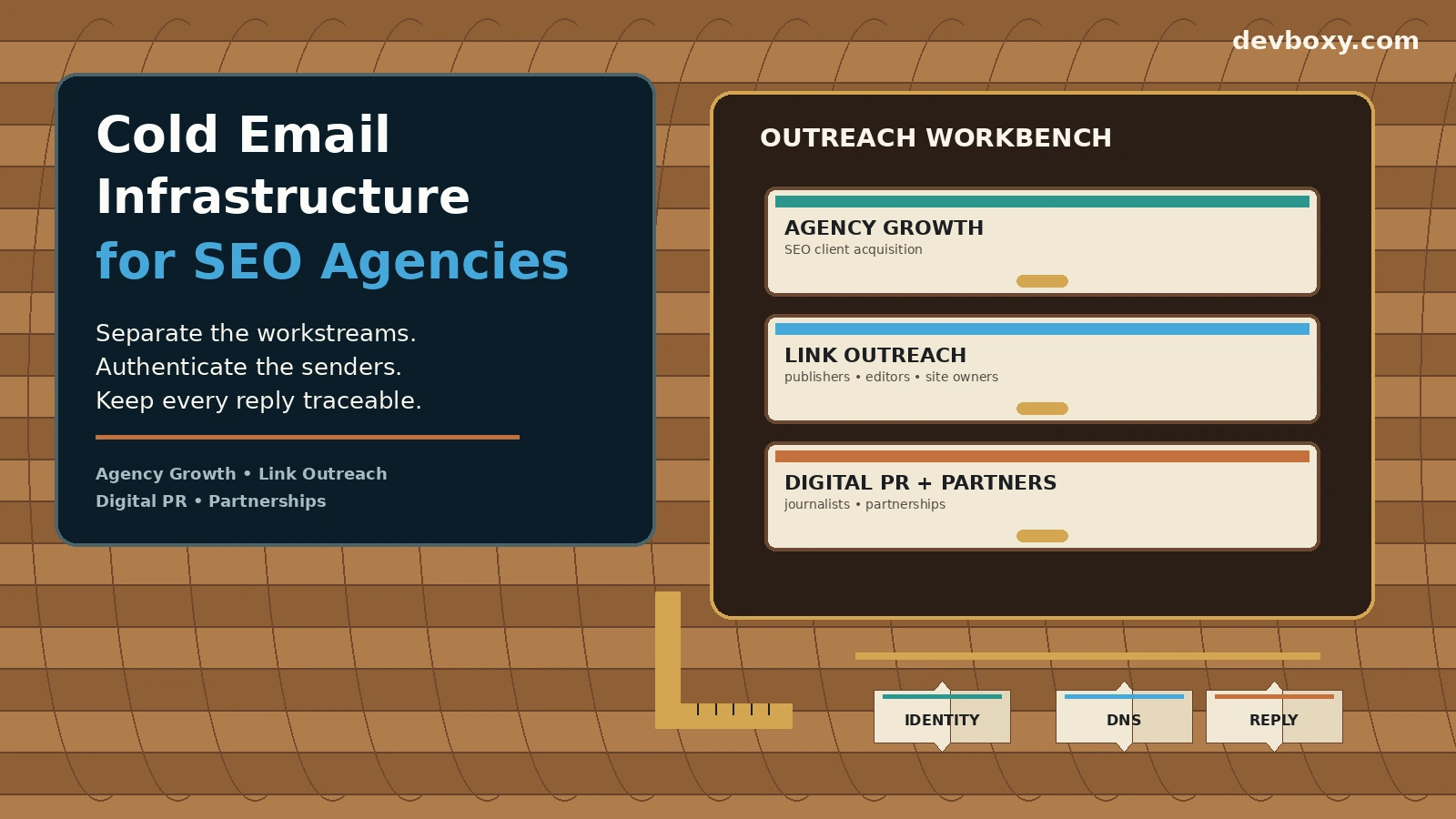
An SEO agency can use cold email for two very different jobs: winning new SEO clients and delivering outreach work for existing clients. Those jobs may both involve prospect lists, sending accounts, follow-ups, and replies, but they should not be treated as one undifferentiated campaign system.
Client acquisition is a sales operation. Link building, guest-post outreach, digital PR, and partnership outreach are delivery operations. They can have different sender identities, list sources, reply owners, success criteria, legal considerations, and reputation risk. The infrastructure should make those differences visible before volume increases.
This guide explains how to build cold email infrastructure for SEO agencies around those realities: sender identity, domains, authentication, mailboxes, list verification, campaign separation, reply routing, suppression, monitoring, and reporting. It is narrower than the broader agency operations playbook. The focus here is the technical and operational foundation that lets an SEO agency run outreach without mixing client growth, link acquisition, and client-delivery workflows.
Key Takeaways
Separate agency client acquisition from client-delivery outreach as distinct operating programs, even when the same team manages both.
Decide who the sender of record is before creating domains, mailboxes, copy, or campaigns. An agency-branded sender and a client-branded sender create different ownership and compliance obligations.
Do not use subdomains as a way to pretend traffic is unrelated. Google can evaluate bulk-sender status at the primary-domain level, including traffic from subdomains.
Authenticate every sending domain correctly and monitor the actual messages being sent, not merely the DNS records you intended to configure.
Verify outreach data before launch, but keep editorial, role-based, and generic business addresses under a human decision policy rather than blindly treating every non-personal address as unusable.
Keep suppression durable. Re-importing a prospect list must never make a previously opted-out contact eligible again.
Use replies and business outcomes as the primary operating evidence. Opens can be noisy and should not drive aggressive follow-up decisions by themselves.
Start With Two Separate Outreach Lanes
The first infrastructure decision is not which mailbox provider to buy. It is which operating lane the outreach belongs to.
Operating lane | Typical SEO use cases | Likely sender | Primary outcome |
|---|---|---|---|
Agency growth | SEO retainers, local SEO, technical SEO, content SEO, link-building services | Agency founder, sales rep, or named growth operator | Qualified reply, discovery call, proposal opportunity |
Client delivery | Link outreach, guest posts, resource-page outreach, digital PR, partnerships | Authorized agency specialist or client-approved identity | Editorial response, collaboration, link opportunity, placement, referral |
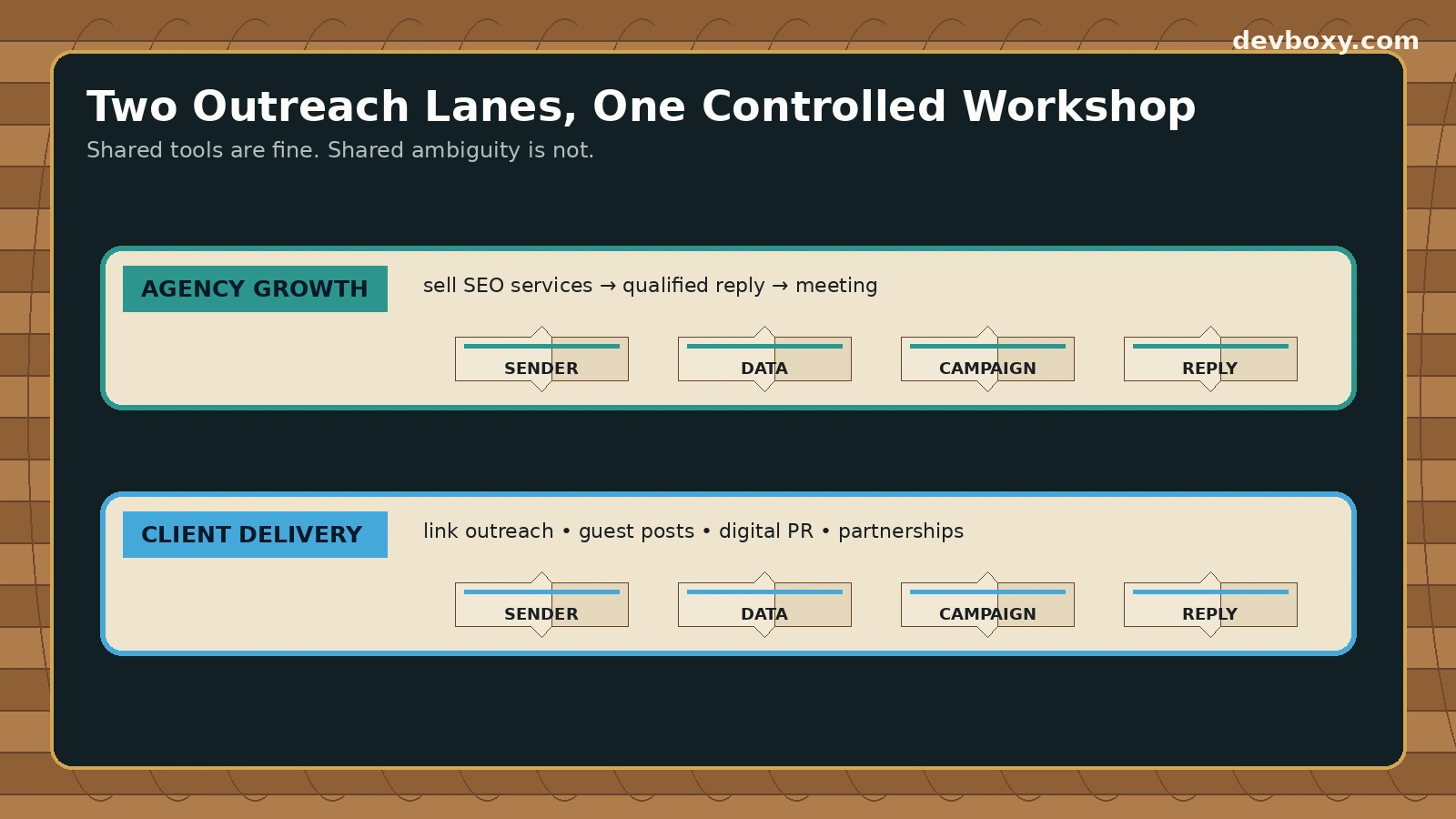
That distinction prevents several common failures. A sales rep should not inherit replies from a journalist pitch. A link-building campaign should not inflate the apparent reply performance of a client-acquisition program. A client’s suppression list should not disappear inside a general agency list. And an agency should not send in a client’s name unless the identity, ownership, and approval model is explicit.
Agency growth is not the same as link outreach
When the agency sells SEO services, the message is commercial prospecting for the agency’s own offer. The audience may be founders, marketing leaders, ecommerce operators, local-business owners, or in-house SEO teams. The value proposition should connect to a real search problem the recipient can verify.
When the agency performs outreach for a client, the audience may be editors, site owners, journalists, content managers, partners, associations, or resource-page owners. The email is often about a specific asset, story, contribution, source, or editorial fit. The operating outcome may be a placement rather than a sales meeting.
Use different campaign definitions, reply categories, and reporting for the two lanes. Shared software is fine. Shared ambiguity is not.
Decide the Sender of Record Before You Provision Anything
Every SEO outreach program needs a written answer to one question: Who is actually sending this email?
For agency-owned client acquisition, that answer is usually straightforward. The sender is the agency or a named person at the agency. For client delivery, there are more possibilities:
the agency sends transparently as the agency on behalf of the client;
a named specialist sends from a client-approved mailbox and identity;
the client sends directly while the agency manages research, sequences, and reporting;
a partnership or PR function uses another approved identity with clear ownership.
Do not make that choice after replies start arriving. Sender identity affects domain ownership, authentication, mailboxes, signatures, legal disclosures, reply handling, permissions, and what happens when the client relationship ends.
Google’s current email sender guidelines require accurate sending practices, authentication, valid DNS, TLS, and low spam rates for mail sent to personal Gmail accounts. Yahoo’s sender requirements similarly emphasize authentication, complaint control, standards compliance, and easy unsubscribe requirements for bulk senders.
Build the Infrastructure as a Stack, Not a Collection of Inboxes
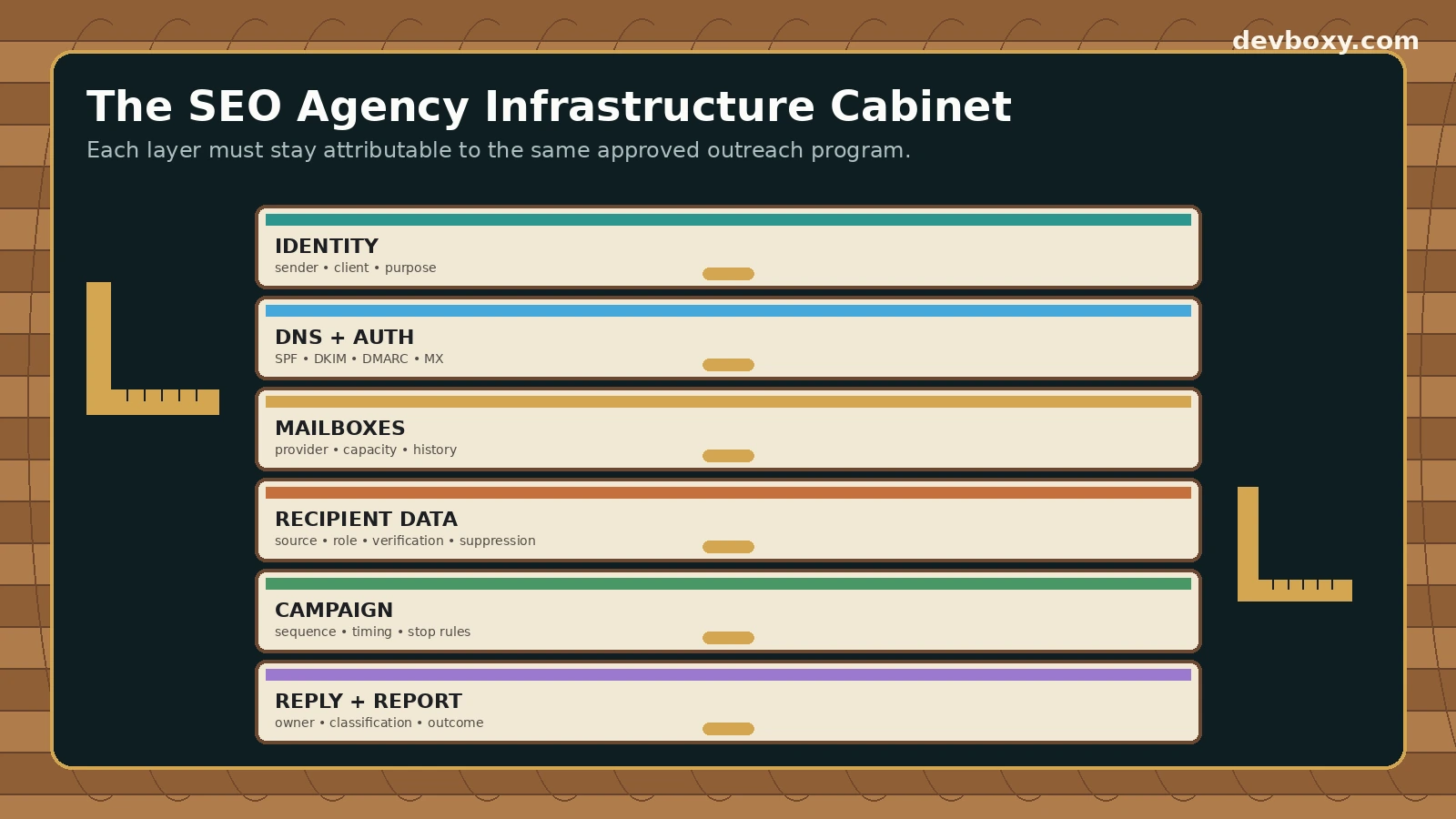
A mailbox is only one layer. A useful SEO agency infrastructure stack has at least six layers:
Identity: agency or client, sender name, From domain, reply owner, approved purpose.
Authentication and routing: SPF, DKIM, DMARC, MX, forward and reverse DNS where applicable, TLS, and tracking-domain configuration when used.
Mailbox capacity: the actual connected sender accounts, provider limits, sending history, errors, and recovery state.
Recipient data: source, role, company, verification status, recency, exclusions, and suppression history.
Campaign logic: audience, message sequence, timing, follow-ups, stop rules, and sender assignment.
Reply and reporting layer: owner, classification, next action, outcome, attribution, and client-visible reporting.
DevBoxy’s current public product pages present email verification, bulk list verification, multiple sending accounts, sequences, automated follow-ups, reply tracking, and deliverability diagnostics as connected parts of an outreach workflow. The DevBoxy homepage describes campaign creation, contact management, email sequences, follow-ups, reply tracking, and deliverability tools in one platform.
For address-level decisions, use the DevBoxy Email Verifier for individual checks and the Bulk Email Verifier for CSV or Excel lists. For domain diagnostics, the DevBoxy network tools include domain health, SPF, DKIM, DMARC, MX, tracking-domain, header, connectivity, and selected blocklist checks.
Keep Outreach Programs Separate Enough to Diagnose
SEO agencies often create one large pool of mailboxes and let every campaign draw from it. That can look efficient until something changes.
Suppose one workstream begins producing high bounce rates, negative replies, or provider deferrals. If the same sender pool is simultaneously used for client acquisition, guest-post outreach, and digital PR, the team may not know which workflow caused the problem. Reporting becomes equally muddy: a high-response editorial campaign can hide weak agency-sales performance.
A better model is to define a boundary for each outreach program. That boundary can include:
an approved sender identity;
a defined domain or domain pool;
a mailbox group;
a recipient-source policy;
a campaign purpose;
a reply owner;
a suppression scope;
an outcome definition.
This does not mean every tiny campaign needs its own infrastructure. It means the agency should be able to trace every send, reply, complaint, bounce, and opt-out to the program that created it.
Do not use subdomains to evade provider classification
Google’s current bulk-sender FAQ explains that messages from subdomains can count toward the same primary-domain bulk-sender threshold. If a primary domain sends close to 5,000 or more messages to personal Gmail accounts within 24 hours, Google can classify it as a bulk sender, and that status does not expire once assigned. Creating additional subdomains is therefore not a reliable way to reset sender classification.
Infrastructure separation should exist for ownership, diagnosis, and reputation management—not to disguise related traffic.
Authenticate Every Sending Domain Before Outreach Starts
SEO agencies often understand DNS conceptually but still launch domains with incomplete or mismatched records because the sending provider, tracking domain, return path, and From domain were configured at different times.
Before a sending domain becomes eligible, check the actual setup:
SPF authorizes the systems that legitimately send for the domain;
DKIM signing is active and the selector resolves correctly;
DMARC exists and alignment matches the intended From identity;
MX records support the reply path you expect;
forward and reverse DNS are correct for self-managed sending infrastructure where required;
TLS is used for message transmission;
tracking domains, if used, are configured and attributable to the correct program;
a real test message shows the authentication results you intended.
The Email DNS Checker consolidates SPF, DKIM, DMARC, and MX review. The Domain Health Checker adds a broader operational view and is explicitly positioned for pre-launch checks, weekly agency monitoring, and troubleshooting after bounce changes.
When you need a narrower diagnostic, use the SPF Checker, DKIM Checker, DMARC Checker, or MX Checker.
Ramp Sending From Evidence, Not From a Spreadsheet Target
Mailbox software limits are capacity ceilings. They are not automatically safe sending targets.
Google recommends increasing volume gradually, avoiding sudden spikes, sending at a consistent rate, and reducing volume when bounces or temporary deferrals rise. That principle matters to SEO agencies because link outreach and client acquisition can produce bursty behavior: a new content campaign launches, a large list becomes available, or several clients start at once.
Use a controlled ramp for each new or materially changed sender group. Watch:
provider rejections and temporary deferrals;
hard bounces;
user-reported complaints where provider data is available;
reply and opt-out patterns;
unexpected authentication failures;
large changes in one provider or recipient segment.
Do not increase volume merely because a mailbox has been active for a certain number of days. Sender readiness is an evidence question, not a calendar milestone.
Build SEO Prospect Lists Around Ownership, Not Just Keywords
SEO outreach fails when the list answers “Which websites exist?” but not “Who owns this decision?”
For agency client acquisition, likely ownership can include founders, heads of marketing, growth leaders, ecommerce managers, local-business owners, or in-house SEO leaders. For link and content outreach, ownership may sit with editors, content managers, journalists, webmasters, partnership managers, resource-page owners, or communications teams.
The useful list fields change by use case:
Field | Agency client acquisition | Link / editorial outreach |
|---|---|---|
Account fit | Industry, geography, size, business model, SEO maturity | Topical relevance, audience, editorial scope, link context |
Contact role | Budget or problem owner | Editor, writer, site owner, PR or partnership owner |
Reason to contact | Observable search gap, business trigger, relevant offer | Specific asset, source, page, story, contribution, or partnership fit |
Success event | Qualified conversation or meeting | Editorial response, introduction, link opportunity, placement, collaboration |
Verification then answers a different question: whether the email address has usable technical evidence. DevBoxy’s bulk verification page separates valid, risky, invalid, and catch-all outcomes and explicitly leaves risky-address decisions to the campaign team rather than removing them automatically.
Role-based addresses require context
SEO outreach is one of the cases where a generic mailbox can sometimes be operationally relevant. An editorial team may intentionally publish an address such as an editor, partnerships, press, or content mailbox. That does not make every role address appropriate to contact, and it does not make it equivalent to a verified named decision-maker.
Keep the address type visible. Decide by source, role, publication context, campaign purpose, and prior response history rather than applying a blanket rule.
Use a Pre-Launch Joinery Check: Everything Must Fit
A cold email campaign should launch only when its parts fit together. For SEO agencies, a pre-launch review can be organized into five joints:
Identity joint: the sender, client, From domain, reply identity, and campaign purpose agree.
Infrastructure joint: DNS, authentication, routing, sender connection, and tracking configuration are healthy.
Data joint: list source, role, verification, exclusions, and suppression have been reviewed.
Message joint: the offer or outreach reason is specific, supportable, properly personalized, and consistent with the sender identity.
Conversation joint: replies, opt-outs, referrals, out-of-office messages, and ambiguous responses have owners and stop rules.
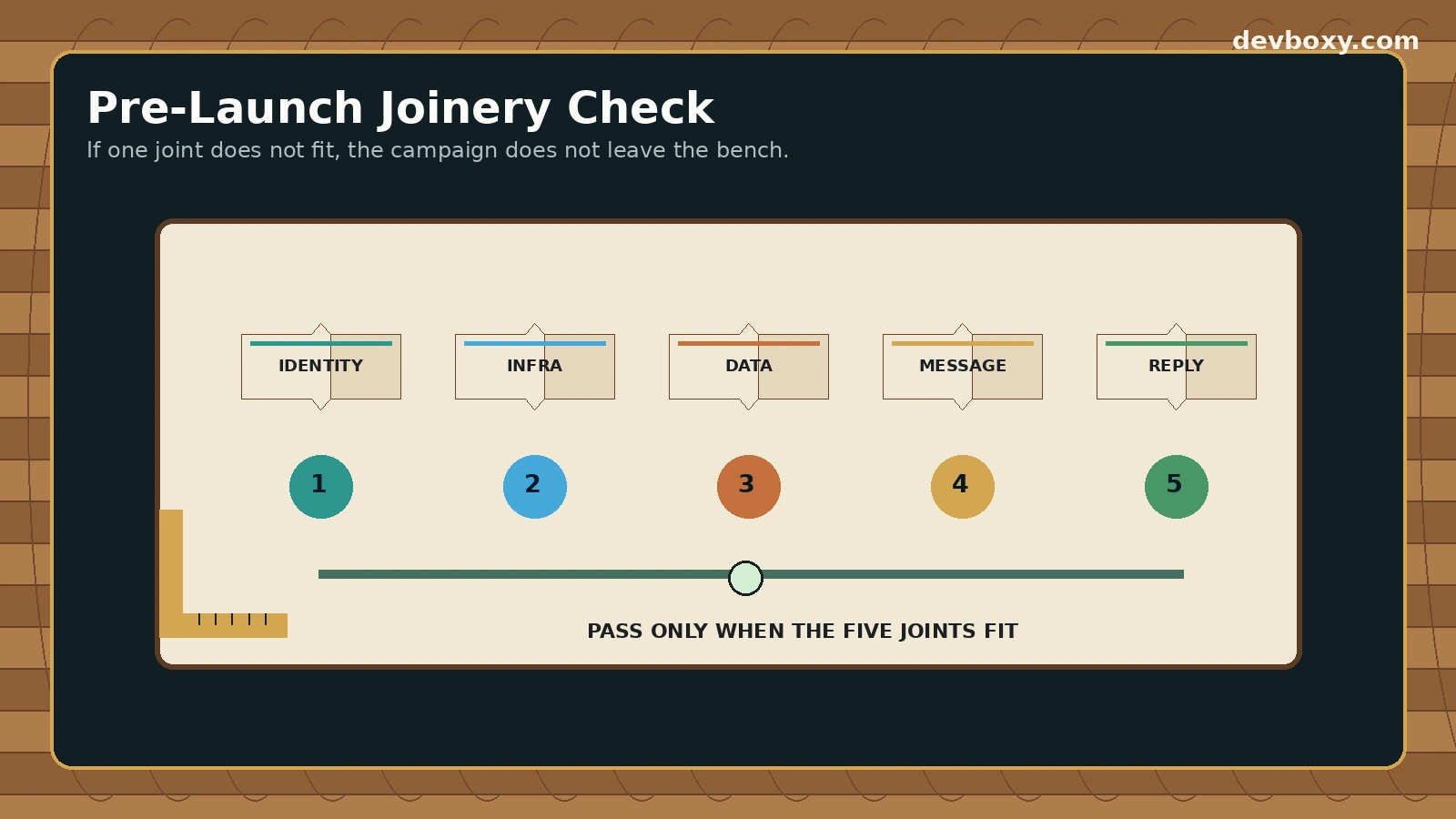
The campaign should not go live merely because the sequence copy has been approved. A perfect email attached to the wrong sender, wrong audience, broken reply path, or stale list is still an operational failure.
Make Reply Routing Match the SEO Use Case
The same word “reply” can represent different business events depending on the campaign.
For agency sales, useful categories include positive interest, objection, timing, wrong person, referral, opt-out, and no fit. For link or PR outreach, useful categories might include interested, send details, editorial rejection, paid-placement request, wrong contact, contributor guidelines, later, referral, opt-out, or automated response.
The inbox owner should see enough context to act without rebuilding the campaign history:
which client or agency lane owns the conversation;
which sender mailbox and From identity were used;
which page, asset, service, or editorial idea was referenced;
which sequence step produced the reply;
whether another automated step is still scheduled;
the prospect’s source and prior suppression state;
the required next action and owner.
When a real human reply arrives, stop the current automated path before deciding what the response means. Classification can happen afterward. Continuing to send while a conversation is active is a worse failure than taking extra time to categorize it.
Keep Suppression Durable Across SEO Campaigns
SEO agencies frequently refresh lists, re-crawl domains, merge prospect databases, and import contacts from client spreadsheets. That makes suppression governance especially important.
A durable suppression record should survive:
new CSV imports;
campaign duplication;
sender changes;
list enrichment;
account-manager handoffs;
campaign relaunches.
Legal requirements vary by jurisdiction, audience, data source, and message purpose. In the United States, the FTC’s CAN-SPAM compliance guide applies to commercial email, including B2B email, and requires accurate identity, non-deceptive subjects, a valid postal address, a clear opt-out method, and honoring opt-outs within the required period.
In the United Kingdom, the ICO’s current B2B marketing guidance distinguishes corporate subscribers from sole traders and some partnerships, while data-protection obligations can still apply when personal data is used. Treat legal review as a real operating requirement, not a footer added after the campaign is built.
Monitor by Program, Sender, and Recipient Type
An SEO agency needs to know whether a problem belongs to infrastructure, list quality, targeting, message relevance, or reply operations. That requires more than one total campaign number.
Review performance by:
agency growth vs client delivery;
client;
sending domain;
mailbox;
recipient provider;
list source;
recipient role;
campaign and sequence step;
reply category;
final business outcome.
Useful operational evidence includes accepted sends, hard bounces, deferrals, authentication failures, human replies, positive replies, opt-outs, complaints where available, unowned replies, meetings for sales campaigns, and placements or accepted collaborations for editorial campaigns.
Use the Blacklist Checker as one diagnostic signal when investigating domain or IP reputation, but never treat one blocklist result as a complete deliverability verdict.
Measure SEO Outreach With the Right Outcome
A client-acquisition campaign should not be judged by the same funnel as a link-outreach campaign.
Campaign type | Useful primary outcomes | Supporting diagnostic signals |
|---|---|---|
SEO client acquisition | Qualified replies, meetings held, proposals, pipeline | Delivery failures, objections, wrong-person replies, opt-outs |
Link outreach | Relevant editorial replies, accepted opportunities, placements | Wrong contact, paid-only responses, rejections, list-quality problems |
Digital PR | Journalist interest, source requests, coverage opportunities | Beat mismatch, timing, duplicate pitch risk, reply quality |
Partnership outreach | Introductions, collaboration discussions, approved next steps | Ownership confusion, fit objections, timing responses |
Do not use open rate as the primary success metric. Opens can be affected by privacy protection, image proxies, prefetching, and security systems. Replies and downstream outcomes are harder to fake and closer to the work the campaign is supposed to create.
A Practical SEO Agency Infrastructure Workflow
Define whether the campaign belongs to agency growth or client delivery.
Record the approved sender of record, From identity, domain owner, and reply owner.
Provision the sender group and authenticate the domain before sending.
Use DevBoxy’s combined DNS review and domain health workflow to inspect the setup.
Build the prospect list around decision ownership and campaign purpose, not merely website keywords.
Verify the list, preserve uncertain outcomes, and reconcile the file against suppression before import.
Create a campaign whose message, proof, and CTA match the lane: client acquisition, link outreach, PR, or partnerships.
Assign sender pacing and a controlled ramp based on real provider and sender evidence.
Test replies, opt-outs, referrals, out-of-office behavior, and stop-on-reply before launch.
Launch a controlled cohort, then review results by sender, list source, reply type, and outcome before expanding.
The DevBoxy pricing page shows current plan-level campaign, contact, follow-up, scheduling, and SMTP-account limits. Treat those values as software entitlements, not recommended sending volumes. The appropriate operating limit is whichever is lower: platform capacity, provider policy, sender health, campaign quality, and your team’s ability to monitor and respond.
SEO Agencies Scale Better When Infrastructure Preserves Context
The strongest infrastructure does not simply send more email. It keeps the work understandable as the agency adds clients, campaigns, domains, mailboxes, and outreach specialists.
For SEO agencies, that means separating client acquisition from client delivery, defining the real sender, authenticating every domain, keeping recipient evidence and suppression intact, giving every reply an owner, and measuring the outcome that matches the use case.
If the agency can trace one prospect from source to verification, sender, message, reply, decision, and final result, the system can be improved. If those facts are mixed across clients and workstreams, scale only multiplies uncertainty.
Use DevBoxy to connect verification, outreach, reply tracking, and deliverability diagnostics, then keep the operating judgment—identity, relevance, legality, ownership, and stop decisions—with the people responsible for the campaign.
Frequently asked questions
What cold email infrastructure does an SEO agency need?
An SEO agency needs a defined sender identity, authenticated sending domains, connected mailboxes, recipient-data and suppression controls, list verification, campaign and follow-up logic, reply ownership, and monitoring. The exact number of domains or mailboxes depends on client count, provider policy, sender history, workload, and campaign purpose.
Should SEO client acquisition and link-building outreach use the same mailboxes?
They can technically share tooling, but mature operations should treat them as separate programs because the audiences, senders, reply owners, success criteria, list sources, and reputation signals differ. At minimum, the agency should be able to trace and control each workstream independently.
Should SEO agencies use separate sending domains?
Separate sending domains can create clearer operational boundaries, but they must be legitimate, controlled by the sender, correctly authenticated, and not deceptive lookalikes. Domain separation is for ownership, diagnosis, and risk management—not for disguising related traffic or bypassing provider requirements.
Do SEO agencies need to verify emails used for link outreach?
Verification is useful because it reduces avoidable address-level failures, but it does not decide whether a contact is the right editor, webmaster, journalist, or business owner. Keep verification status, role, source, editorial context, and suppression history visible so a human can make the final outreach decision.
How should an SEO agency handle role-based editorial addresses?
Do not automatically treat every role-based address as unusable. Editorial, press, partnerships, or content addresses can be intentionally published for relevant communication. Review the address source, published purpose, campaign context, prior responses, and applicable legal rules before deciding whether it belongs in outreach.
How does DevBoxy fit into an SEO agency outreach stack?
DevBoxy currently presents single and bulk email verification, campaign creation, multiple sending accounts, sequences, automated follow-ups, reply tracking, and network and deliverability diagnostics. Agencies still own sender identity, client authorization, data sourcing, audience relevance, legal review, reply quality, and the decision to pause or stop.